Turkey, Saudi Arabia and Pakistan signed the 'Mecca Joint Defence Agreement' on August 7, according to Turkey's defence ministry, which publicly described the pact's terms at a weekly briefing in Ankara on August 13. The accord stipulates that an armed attack against any of the three states shall be regarded as an attack against all — language both sources describe as comparable to NATO's Article 5 collective defence clause.
Turkey, Saudi Arabia and Pakistan sign 'Mecca Joint Defence Agreement' with collective defence clause
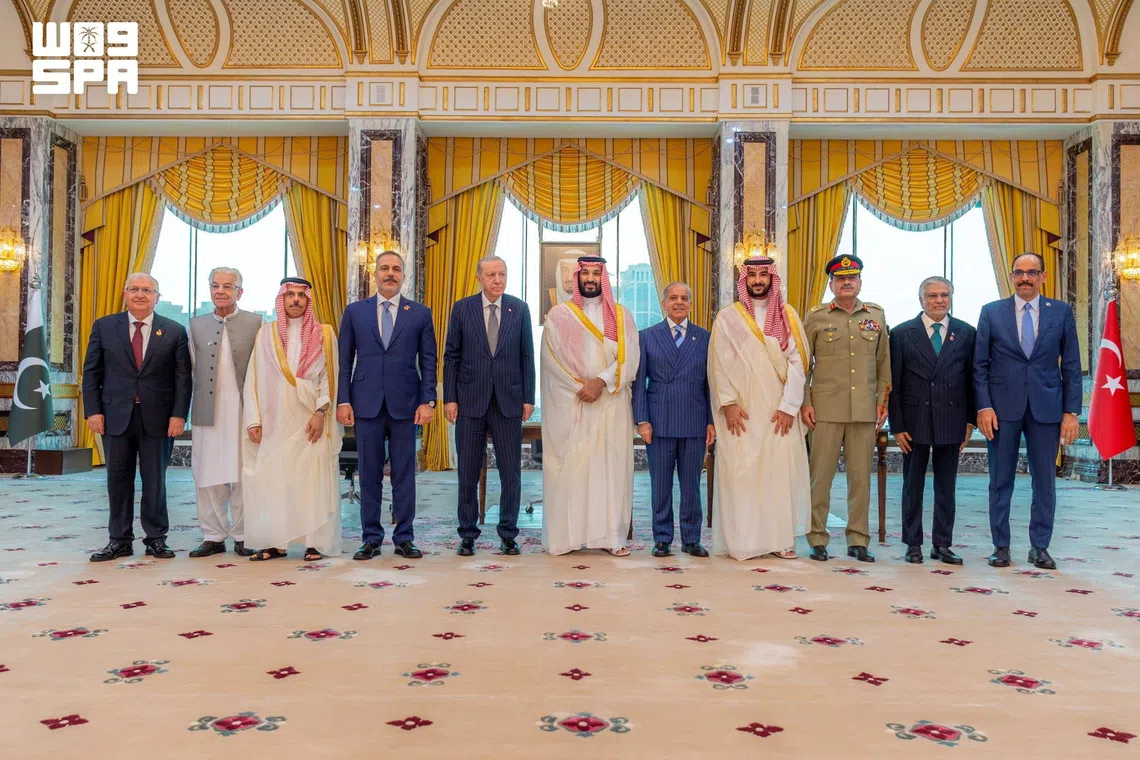
Turkey, Saudi Arabia and Pakistan signed the 'Mecca Joint Defence Agreement' on August 7, according to Turkey's defence ministry, which publicly described the pact's terms at a weekly briefing in Ankara on August 13. The accord stipulates that an armed attack against any of the three states shall be regarded as an attack against all — language both sources describe as comparable to NATO's Article 5 collective defence clause.
Turkey's defence ministry stated that the pact's fundamental goal was to place defence and military ties on a 'more institutional and sustainable' footing. It said strategic political and military mechanisms would be established involving the Defence Ministers, Foreign Ministers, and Chiefs of General Staff of the three countries, with coordination to be conducted at the highest level.
The ministry added that joint military exercises involving land, naval, and air forces, as well as air defence and unmanned systems, were planned. It said defence industry cooperation would go beyond product and system supply to encompass joint development and production, technology cooperation, and maintenance and logistics support, with unmanned and autonomous systems, electronic warfare, and artificial intelligence prioritised.
According to The Atlantic, the pact will include a new organisation overseen by a secretariat in Saudi Arabia, alongside regular meetings among foreign and defence ministers and military chiefs of the three countries.
Turkey, which has NATO's second-largest army, is party to the agreement alongside nuclear-armed Pakistan and Saudi Arabia, the world's top oil exporter. Both sources note that Turkish Foreign Minister Hakan Fidan compared the new organisation to NATO and indicated that Egypt — described by The Atlantic as the most populous Arab state — is likely to join. Turkey's defence ministry confirmed that the pact was open to expansion and did not seek to replace any existing alliances.
Turkey's defence ministry also stated, according to The Straits Times, that Turkey was participating in meetings in Jeddah aimed at establishing an international coalition to protect Red Sea shipping.
The Atlantic characterised the pact as highlighting Iran's regional isolation, noting that two of the three signatories — Turkey and Pakistan — share land borders with Iran. The outlet cited a series of recent tensions: Iranian missiles reportedly intercepted over Turkish airspace earlier this year, Iranian military exchanges of strikes with Pakistan in 2024, attacks on Saudi Arabia attributed to Iran in recent weeks, and Tehran-backed militia activity targeting Saudi interests in Yemen and Iraq. It also noted Iran's historical support for the Assad government in Syria, which was overthrown in 2024 by rebels backed by Turkey and Saudi Arabia.
The Atlantic further noted that Iran reestablished diplomatic ties with Saudi Arabia in 2023 and had sought to improve those relations, and that Iran has historically maintained strong cultural and political ties with both Turkey and Pakistan.
According to The Atlantic, an Iranian government spokesperson responded to the pact with what the outlet described as 'studied nonchalance,' claiming to welcome the arrangement as evidence that member countries would no longer rely on the United States. A reformist civil-society activist, cited by The Atlantic, suggested the agreement could be 'an opportunity, not a threat' and that Iran could one day join it. However, Ebrahim Azizi, described as the head of Iran's parliament's foreign-policy committee, posted on social media that the Mecca three 'haven't found the right path yet,' adding: 'We warn them about miscalculations. No mistake will go unanswered.'
The Atlantic noted scepticism about the pact's practical significance, pointing out that Saudi Arabia and Pakistan had signed a similar agreement the previous year but did not invoke it when Saudi Arabia came under attack during the current conflict.
The Atlantic also noted that Israel is absent from the emerging security arrangement. It observed that Saudi Arabia has conditioned recognition of Israel on progress toward formation of a Palestinian state, that Pakistan does not recognise Israel, and that Turkey and Israel have drifted apart in recent years despite maintaining diplomatic and military relations.
Where sources differ
- The two sources characterise the pact's significance differently: The Straits Times presents it primarily as a defence and military cooperation framework described in institutional terms by Turkey's ministry, without drawing explicit conclusions about regional geopolitics; The Atlantic frames it explicitly as a signal of Iran's growing regional isolation and analyses its broader implications for the regional order, including for Israel.
- Neither source provides official statements from Saudi Arabia's or Pakistan's governments on the pact's terms or intentions beyond what was conveyed at the Ankara briefing.
- The precise circumstances and content of the signing ceremony on August 7 are not described in detail by either source.
- The current status and progress of the Jeddah meetings on Red Sea shipping protection are not elaborated upon.
- Whether Egypt has been formally invited to join the pact, or on what timeline it might do so, is not established.
- The nature and scale of the 'similar deal' reportedly signed by Saudi Arabia and Pakistan the previous year, referenced by The Atlantic, is not explained.
- Neither source provides a response to the pact from Israel, the United States, or other regional powers such as the UAE or Jordan.
- The full text of the Mecca Joint Defence Agreement is not reproduced or summarised beyond the collective-defence clause and the institutional arrangements described.
- The Straits Times — original — by The Straits Times
- The Atlantic — by Arash Azizi
Read the original at The Straits Times