Twenty-five years after the Ohrid Framework Agreement ended a six-month conflict between ethnic Macedonian security forces and ethnic Albanian insurgents in what is now North Macedonia, analysts and political figures say the country has maintained peace but has not achieved genuine reconciliation, while disputes over minority rights and representation continue under a changed political landscape.
North Macedonia marks 25 years since Ohrid Agreement amid ongoing ethnic divisions
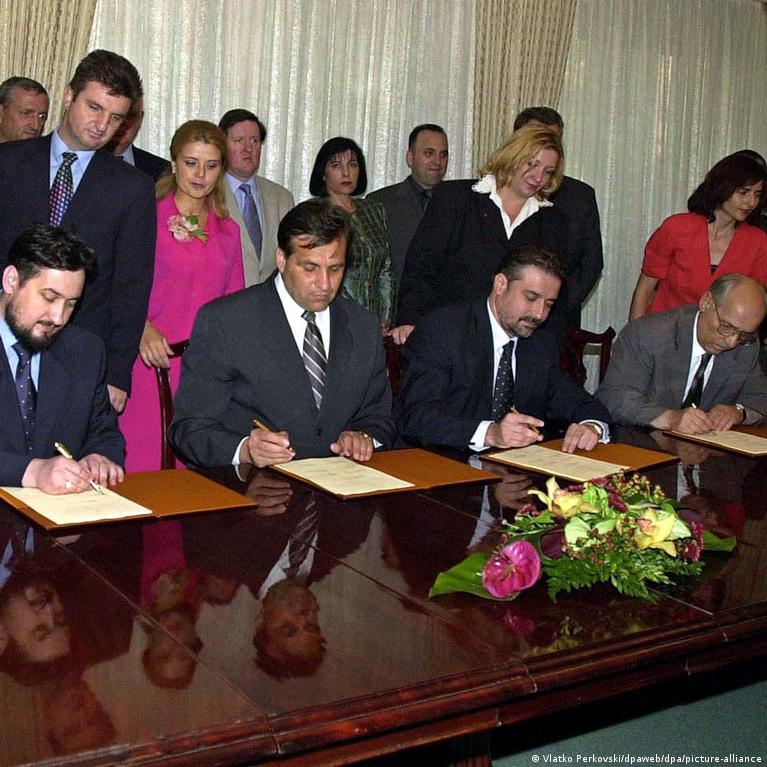
Twenty-five years after the Ohrid Framework Agreement ended a six-month conflict between ethnic Macedonian security forces and ethnic Albanian insurgents in what is now North Macedonia, analysts and political figures say the country has maintained peace but has not achieved genuine reconciliation, while disputes over minority rights and representation continue under a changed political landscape.
The 2001 conflict, which began in February of that year, is often characterized as the final chapter of the violent breakup of former Yugoslavia. It claimed the lives of 72 soldiers and police officers; the number of ethnic Albanian insurgents killed remains disputed, with estimates ranging from approximately 100 to several hundred. More than 170,000 people were displaced, including 74,000 within the country.
The conflict was contained before escalating further, in part through a political compromise brokered by NATO, the United States, and leading EU countries. The resulting Ohrid Framework Agreement reshaped North Macedonia's political system by introducing power-sharing mechanisms intended to give minority communities greater influence in decision-making. Under the arrangement, legislation touching on sensitive areas such as language, education, and national symbols requires support not only from a parliamentary majority but also from minority representatives.
According to the most recent census, ethnic Albanians constitute more than a quarter of North Macedonia's population of 1.8 million.
The political order established by the agreement entered a new phase approximately two years ago when the conservative VMRO-DPMNE party returned to power, sending the Democratic Union for Integration (DUI), the main ethnic Albanian party, into opposition. This ended roughly two decades of governing influence for Ali Ahmeti, who had led the ethnic Albanian National Liberation Army during the 2001 conflict before becoming a prominent political figure.
North Macedonia became an EU candidate country in 2005, but formal accession negotiations have not yet begun. The country resolved a long-running dispute with Greece over its name, but subsequently faced new obstacles arising from Bulgaria's demands concerning history, language, and national identity. Observers note that the stalled EU integration process has deepened interethnic tensions by removing one of the few unifying goals shared by both communities. The country is due to mark 35 years of independence from former Yugoslavia next month.
Harald Schenker of the German peacebuilding organization Pro Peace told DW that ethnic distance in North Macedonia is increasing, the education system remains segregated, and mutual understanding between the two communities is diminishing. He said the Ohrid Agreement transformed the country's institutions and rules of governance but did not foster reconciliation or a shared vision for the future, with each side retaining its own interpretation of what occurred in 2001.
- The current VMRO-DPMNE government's stated position on minority rights, the Ohrid Agreement's implementation, and the specific policy changes described by DUI officials as erosions is not presented in the source.
- Independent verification of claims made by either ethnic Albanian or ethnic Macedonian political figures regarding specific policy changes since VMRO-DPMNE returned to power is not provided.
- The exact number of ethnic Albanian insurgents killed in the 2001 conflict is described as disputed; no authoritative figure or body is cited as the source of competing estimates.
- No detail is provided on the specific legal or administrative changes the current government has made that are referenced by Osmani and Ahmeti.
Read the original at Deutsche Welle