Water levels on the Rhine River have dropped to approximately 16 centimetres at Kaub — a critical gauge point between Mainz and Koblenz — as of Monday, according to Germany's Federal Waterways and Shipping Administration. The figure is well below the 40-centimetre threshold considered the minimum for standard commercial vessels, and the head of Germany's inland shipping association has warned the river may become entirely unnavigable at that point before the end of the week.
Rhine water levels fall to near-record lows, threatening to split river for commercial traffic
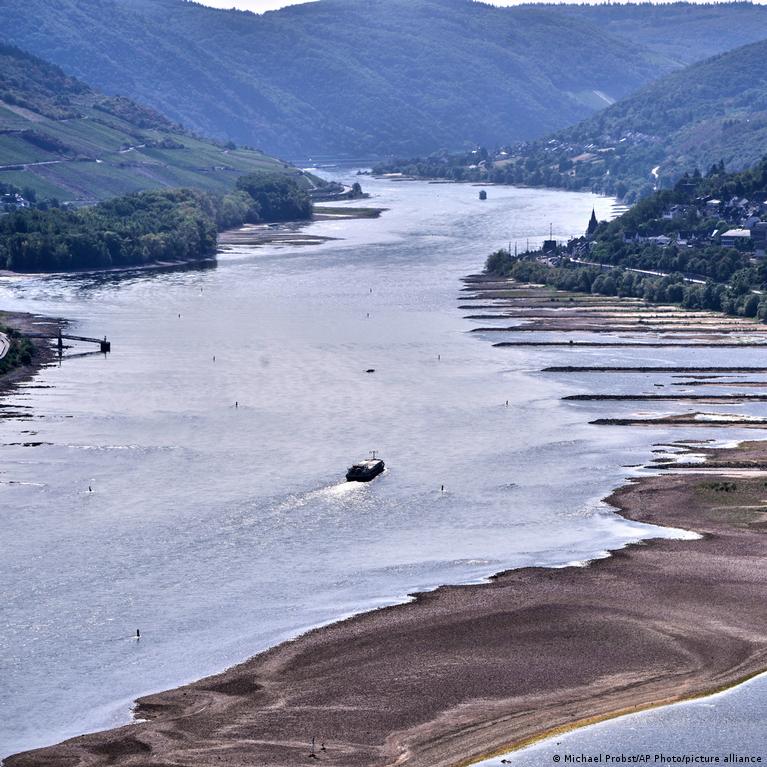
Water levels on the Rhine River have dropped to approximately 16 centimetres at Kaub — a critical gauge point between Mainz and Koblenz — as of Monday, according to Germany's Federal Waterways and Shipping Administration. The figure is well below the 40-centimetre threshold considered the minimum for standard commercial vessels, and the head of Germany's inland shipping association has warned the river may become entirely unnavigable at that point before the end of the week.
The gauge at Kaub is used by ship operators to determine how much cargo their barges can safely carry and whether passage is feasible at all. According to local media, carriers have in recent weeks reduced cargo loads to as little as one-fifth of normal capacity along the Rhine.
Low water conditions are not confined to the Middle Rhine — the roughly 130-kilometre stretch between Mainz and Bonn that is the narrowest and shallowest section. Areas around Cologne, Düsseldorf, Duisburg-Ruhrort and Emmerich are also reportedly at historic lows.
Jens Schwanen, head of the BDB association of inland shipping, told the Rheinische Post on Monday that a single-digit water reading at the Kaub gauge was forecast for the first time this week. He said this would effectively divide the Rhine into two separate navigable zones: one linking North Sea ports in Amsterdam, Rotterdam and Antwerp to the Cologne region via the Rhine and the western German canal network, and another operating on tributaries including the Neckar, Moselle and Main, as well as the Main-Danube Canal.
Between those two zones, shipping companies would seek to transfer cargo to trucks and freight rail. However, the typical load of a single large barge — equivalent to 50 to 150 truckloads — cannot be absorbed by Germany's road network without significant congestion and higher costs.
Baden-Württemberg announced Monday it would join four other German states in easing Sunday truck-movement restrictions to help manage anticipated congestion. Following talks the previous Thursday, Transport Minister Steffen Bilger announced additional measures including reducing bureaucratic requirements for heavy road loads, halting non-essential roadworks and improving coordination with DB Cargo, the rail freight division of Deutsche Bahn.
Germany relies on inland waterways to transport approximately 5% of goods nationally, predominantly bulk materials such as iron ore, coal, sand and petroleum products. According to BDB figures, 173 million tonnes of goods were carried by inland water out of 3.28 billion tonnes transported in total during 2024. Eurostat calculated in 2023 that the Rhine corridor — from the Port of Rotterdam to the German-Swiss border — accounts for around 40% of freight measured by tonne-kilometres.
Research by the Kiel Institute for the World Economy, published in 2023 following two previous droughts, estimated that every 30 days of low water on the Rhine reduces German industrial production by about 1%. The German Economic Institute (IW) has forecast a 0.4% drop in gross domestic product as a result of the current situation, effectively eliminating growth that had been projected at 0.5% for the year. Other experts have cited potential losses of €1 to €2 billion in the third quarter alone, with the steel, chemicals and energy sectors identified as particularly exposed.
Scientists attribute increased frequency and severity of Rhine low-water events to climate change. The EU's Copernicus Climate Change Service reported that western Europe experienced its warmest June and July on record, with low rainfall driving below-average water levels on the Rhine, Danube and Seine. The current episode is the third major low-water event on the Rhine in eight years, following droughts in 2018 and 2022.
The Rhine has historically been supplemented during dry summer months by meltwater from Alpine glaciers and snow. Germany's Federal Institute of Hydrology projected in 2023 that severe low-water events comparable to 2018 could occur every five to ten years by mid-century as glaciers retreat and snow cover declines.
- No response or comment from individual shipping companies or freight operators is included beyond aggregate industry data.
- No statement from the German federal government beyond Transport Minister Bilger's measures is included.
- The source does not specify whether the projected €1 to €2 billion loss figure comes from named institutions or which experts made that estimate.
- No indication of when or whether rainfall is expected to replenish water levels.
- No comment from port authorities in Rotterdam, Amsterdam or Antwerp on operational impacts.
Read the original at Deutsche Welle