Flash floods triggered by a glacial collapse on Wednesday along the Nepal-Tibet border have killed more than 500 people and left thousands missing, with rescue operations repeatedly interrupted by a debris-dam lake that overflowed on Friday, forcing evacuations and a temporary suspension of search efforts in the Himalayan disaster zone.
Death toll rises above 500 as rescuers face secondary flood threat on Nepal-Tibet border
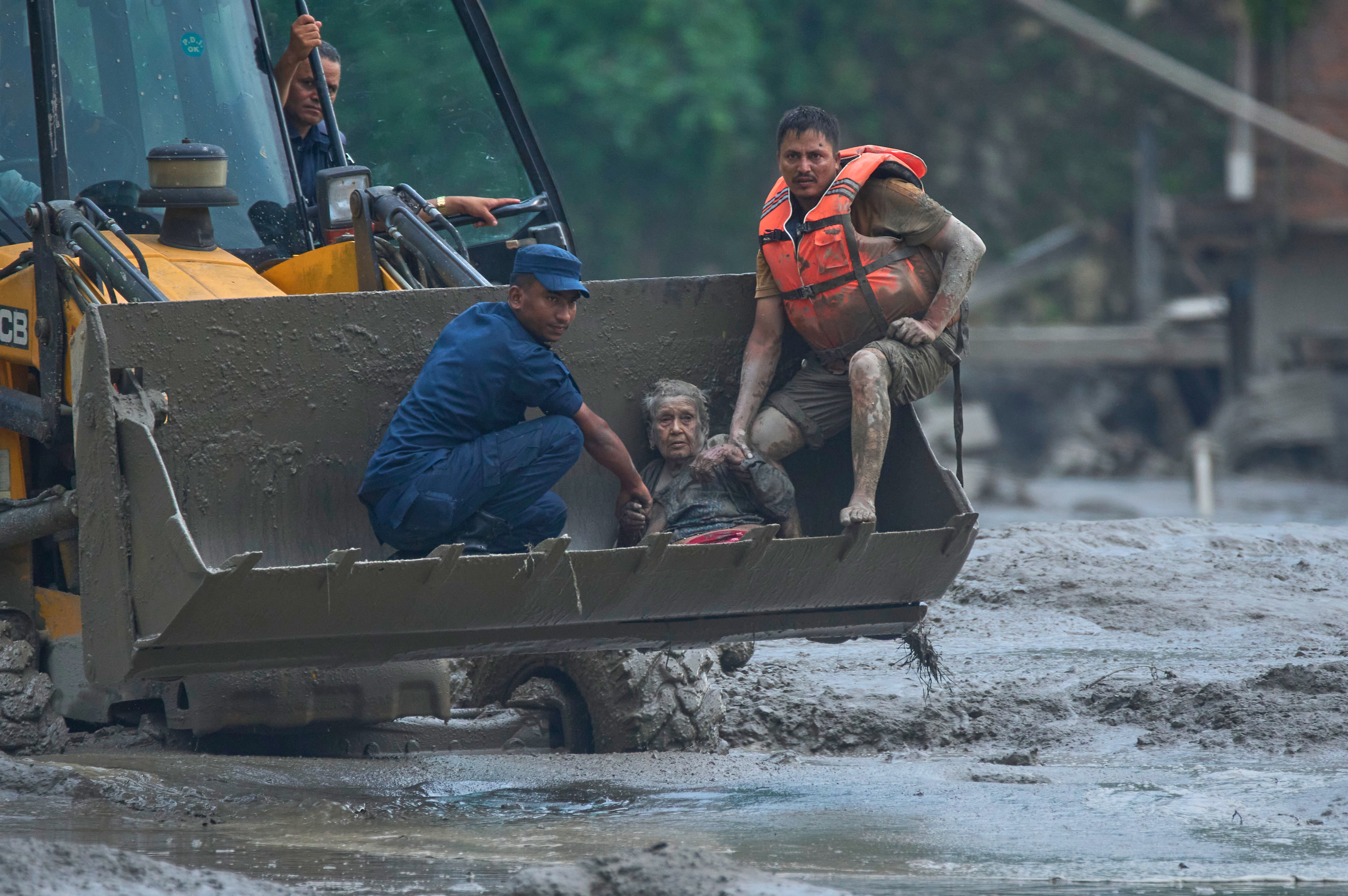
Flash floods triggered by a glacial collapse on Wednesday along the Nepal-Tibet border have killed more than 500 people and left thousands missing, with rescue operations repeatedly interrupted by a debris-dam lake that overflowed on Friday, forcing evacuations and a temporary suspension of search efforts in the Himalayan disaster zone.
The disaster originated when a massive chunk of ice broke from a glacier and fell thousands of feet into the valley below, sending rock, ice and mud surging down rivers and destroying communities along the way, according to initial assessments cited by NPR. The flooding was made more severe because it struck during the monsoon season, when rivers were already swollen and the surrounding soil was fully saturated, according to Mohammad Farooq Azam, an expert at ICIMOD cited by NPR.
Death toll figures varied across sources and across time. France 24 reported at least 552 killed in Nepal as of Friday, while Deutsche Welle reported Nepal's toll had risen to 579 — up from 390 the previous day. The Guardian cited a combined figure of at least 543 dead across both Nepal and China. The New York Post reported at least 547 dead in Nepal. China confirmed five deaths in Tibet, up from an earlier count of three, according to both Deutsche Welle and France 24. The New York Post reported China had confirmed only three fatalities in Tibet at the time of its publication.
Missing-persons figures also differed among sources. Deutsche Welle reported more than 2,000 still believed missing, including over 500 foreigners from more than 30 countries. France 24 reported more than 1,400 missing. The Guardian cited 826 missing in Nepal, of whom more than 500 were foreign nationals, including 177 from India, 90 from the United States, 34 from Australia, 33 from Britain and 25 from Canada, and said Chinese state media reported at least 558 missing on the Tibet side. The New York Post reported 977 still missing in Nepal and 558 missing in Tibet.
A barrier lake formed by debris upstream became a central hazard. The lake began overflowing on Friday, sending water toward rescue teams and causing residents in Nepal's Rasuwa district to flee up hillsides, according to Deutsche Welle, France 24 and The Guardian. Narendra Pariyar, the most senior bureaucrat of Rasuwa district, told Deutsche Welle: 'We have received a notice saying that the lake has broken its banks. We can see that the level of water in the river is rising.' Authorities later said the immediate threat had eased but that monitoring was continuing, according to Deutsche Welle.
China's Ministry of Water Resources said the lake held roughly 2 million cubic meters of water as of Thursday and was expected to receive an additional 3 million cubic meters over the following three days, equivalent to about 1,200 Olympic swimming pools, with peak flow expected around September 1, according to Deutsche Welle. The lake was surveyed to be approximately 150 metres long and 40 to 50 metres deep, and its debris barrier sits more than 10 kilometres from Gyirong Port at an elevation roughly 1,000 metres above it, according to Deutsche Welle citing Chinese state broadcaster CCTV. China mobilised an eight-member engineering team to conduct aerial surveys and build 3D models of the site, with engineer Chen Hanxiao telling CCTV the general strategy was to dig a drainage channel at a lower point of the dam.
Simon Cook, a glaciologist at the University of Dundee, told France 24 that the debris dam posed serious risks: 'This dam is just made of loose rock and mud and so on, it's not a carefully engineered dam... the worry is that as more water enters that lake, it either overpowers the dam because the dam is just not strong enough to hold it, or it overtops the dam and cuts a notch through the dam material. And then once it starts cutting into that dam, the whole thing could be released.'
Rescue operations were described by specialists as exceptionally difficult. David Alexander, a specialist in emergency response planning at University College London, told France 24: 'We are dealing with just about the most difficult terrain in the world for this kind of rescue.' Daniel Nohrstedt, a crisis management specialist at the University of Uppsala, told France 24: 'I would definitely classify this as one of the more complicated rescue missions there is,' adding that coordinating multiple organisations without a single responsible body was a persistent challenge. Alexander also noted that radio communications can be blocked by high mountain terrain.
The destruction of roads and bridges left helicopter transport as the primary means of access. France 24 reported that Nepal's disaster management authority said more than 3,000 people had been airlifted from the disaster zone by Friday. The Guardian reported that at the army camp in Bidur, rescue and military helicopters flew in and out every five minutes. The Nepal army was also working to free approximately 100 people trapped in a tunnel at the flooded Trishuli 3A hydropower project, with the army spokesperson telling The Guardian that locating entry points to the tunnel was a challenge. The prime minister's office said 350 workers and local people had been rescued from the tunnel, according to The Guardian.
The International Red Cross estimated that over 93,000 people had been directly affected and were in urgent need of humanitarian assistance, Deutsche Welle reported. Red Cross spokesman David Fisher warned of the risk of a secondary flood and noted relief trucks had been blocked by the barrier lake. The World Health Organization warned of disease risks including diarrhoea and respiratory illnesses following displacement, overcrowding and disruption to sanitation and health services, according to Deutsche Welle. Kamal Kishore, Head of the UN Office for Disaster Risk Reduction, said the disaster was 'not yet completely over' and warned of 'cascading hazards that might unfold,' Deutsche Welle reported.
Nepal's Foreign Ministry said on Friday it did not require foreign assistance for search-and-rescue operations, despite requests from multiple countries with nationals still unaccounted for. Spokesperson Lok Bahadur Chhetri was quoted by both Deutsche Welle and The Guardian as saying: 'The offer for help is natural. Our security agencies are doing the search and rescue operation. For now we don't require such help.' According to The Guardian and Deutsche Welle, the countries that had requested permission to deploy teams included India, China, the United States, Britain, Japan, South Korea, Sri Lanka and Bangladesh.
South Korea, which had already sent a response team, confirmed through its Foreign Ministry that Nepal indicated it was not yet ready to accept foreign rescue teams, and said Seoul would 'keep negotiating with Nepal over the matter,' according to Deutsche Welle. South Korea pledged one million US dollars in humanitarian aid through international organisations, after reporting nine nationals missing and ten stranded at a hydropower plant struck by the flood, Deutsche Welle reported. Former Nepali ambassador Dinesh Bhattarai told Reuters, as cited by The Guardian, that the reluctance to accept foreign teams may be linked to sensitivities about Rasuwa district's location on the border with China's Tibet region. Chhetri denied this, saying the decision had nothing to do with China-related sensitivities, according to The Guardian.
Many of those missing were pilgrims or tourists travelling to sacred sites. According to ABC News Australia, most of the 38 missing Australians were pilgrims to Mount Kailash, a peak in south-western Tibet considered sacred by Hinduism, Buddhism, Jainism and the Tibetan Bon tradition, with at least 32 confirmed to have been on trips to the mountain. The Gyirong border crossing destroyed by the initial flood was on a major highway used by pilgrims en route to Kailash. Sagar Pandey, chief executive of tour agency Himalayan Glacier, told Reuters as cited by ABC News Australia that all 15 members of his missing group were Indian Australians, the youngest an 11-year-old boy, and said he believed there was only a 'one per cent chance' of survival after flying over the flood zone by helicopter.
Indian spiritual leader Sadhguru told followers in a video, cited by ABC News Australia, that 11 Australians were among a larger group of pilgrims at the Gyirong immigration centre when it was destroyed, and that a guide had sent a message saying the group had arrived at the facility only moments before the flood struck.
Scientists linked the disaster to climate change. Twila Moon, deputy lead scientist at the National Snow and Ice Data Center at the University of Colorado Boulder, told NPR: 'There's no question that this event was made more likely because of climate change and that we're seeing more likely other similar glacier hazards occurring.' Arun Bhakta Shrestha, a climate and Himalayan glacier expert, told NPR that the frequency and types of hazards across the Hindu Kush Himalayan region appeared to be increasing and that everything pointed to climate change as the reason. Alton Byers, a faculty research scientist at the Institute of Arctic and Alpine Research at the University of Colorado Boulder, told NPR permafrost instability caused by warming was contributing, comparing the melting frozen ground to butter left out of a refrigerator losing its structural integrity.
NPR reported that preliminary assessments indicated Nepal's flood warning system was not equipped to handle these floods, despite significant government investment in warning infrastructure over the previous decade, and that the government had struggled with the cost of maintaining existing systems.
Humanitarian organisations mobilised rapidly. Direct Relief had pre-positioned emergency medical supplies in Nepal ahead of the monsoon season and was preparing additional shipments by Thursday, with vice president Dan Hovey telling NBC Connecticut: 'This is going to be a long recovery process.' NBC Connecticut listed several US-based organisations already operating in Nepal, including All Hands and Hearts, Catholic Relief Services partnered with Caritas Nepal, GlobalGiving, which launched a Nepal Flood Relief Fund with a target of 1.5 million dollars, Humanity and Inclusion, Save the Children — which said it had already delivered cooking kits, mosquito nets and blankets to 1,000 households — and World Central Kitchen.
In a separate criminal matter related to the disaster, two men were arrested in Nepal on Thursday after video of them allegedly stealing earrings from the body of a flood victim went viral, according to the New York Post. Madan Gurung, 25, and Umesh Chaudhary, 38, were arrested at a bus station in Bharatpur after the footage, released by Nepal police, appeared to show them using wooden logs to bring a body ashore before taking jewellery from it. Chitwan police chief Rameshwar Paudel warned that stealing from victims would not be tolerated, according to the New York Post citing local outlet Khabarhub. The New York Post reported it was unclear whether charges had been filed.
Where sources differ
- Death toll in Nepal: France 24 reported at least 552; Deutsche Welle reported 579; The Guardian cited a combined Nepal-China figure of at least 543; the New York Post reported 547 in Nepal. Figures reflect different reporting times.
- Death toll in Tibet/China: France 24 and Deutsche Welle both reported China raised its count from three to five. The New York Post reported only three confirmed deaths in Tibet, reflecting an earlier count.
- Total missing: Deutsche Welle reported more than 2,000 still missing overall; France 24 reported more than 1,400 missing; The Guardian cited 826 missing in Nepal plus at least 558 on the Tibet side; the New York Post cited 977 missing in Nepal and 558 missing in Tibet.
- Number of Australians missing: ABC News Australia reported 38 missing Australians; The Guardian cited 34 from Australia.
- Characterisation of barrier lake flood risk: Deutsche Welle and The Guardian described the threat as serious and ongoing; the New York Post cited CNN's report of Chinese state broadcaster CCTV saying risks were considered 'manageable.'
- A definitive, agreed-upon death toll had not been established across sources at time of reporting, with figures varying by outlet and publication time.
- The exact number of missing persons remained unresolved, with sources giving figures ranging from approximately 1,400 to more than 2,000.
- The fate of the majority of missing foreign nationals, including the 38 (or 34, per The Guardian) Australians, had not been determined.
- Whether charges were filed against the two men arrested for allegedly stealing jewellery from a flood victim was not confirmed in any source.
- The outcome of China's engineering efforts to drain the barrier lake had not been reported at the time sources were published.
- Independent or non-state-media reporting on the scale of destruction on the Tibetan side of the border was absent; sources noted China's Tibet region is tightly controlled and only brief state-media accounts were available.
- The precise cause and timeline of the glacial collapse had not been formally established by a scientific or government investigation cited in the sources.
- Whether Nepal's flood warning system failure would prompt formal review or reform was not addressed by any source.
- The full list of foreign nationals missing by country was only partially provided; the status of nationals from many of the more than 30 countries reportedly affected was not detailed.
- Long-term recovery plans and funding commitments beyond immediate emergency response were not specified in any source.
- NBC Connecticut — original — by Glenn Gamboa | The Associated Press
- Deutsche Welle — by Seerat Chabba
- ABC News Australia — by Will Jackson
- France 24 — by Sébastian SEIBT
- New York Post — by Chris Bradford
- NPR News — by Ava Berger
- The Guardian — by Staff and agencies
Read the original at NBC Connecticut