US President Donald Trump confirmed on Tuesday that he secretly boarded a different military aircraft when departing Turkey on 8 July after attending a NATO summit in Ankara, following what officials described as a credible Iranian threat to shoot down Air Force One. The operation, which involved transporting Trump to and from aircraft inside a catering truck, was first reported by the Washington Post on Monday before Trump acknowledged the switch to reporters.
Trump confirms secret plane switch during Turkey departure amid reported Iranian missile threat
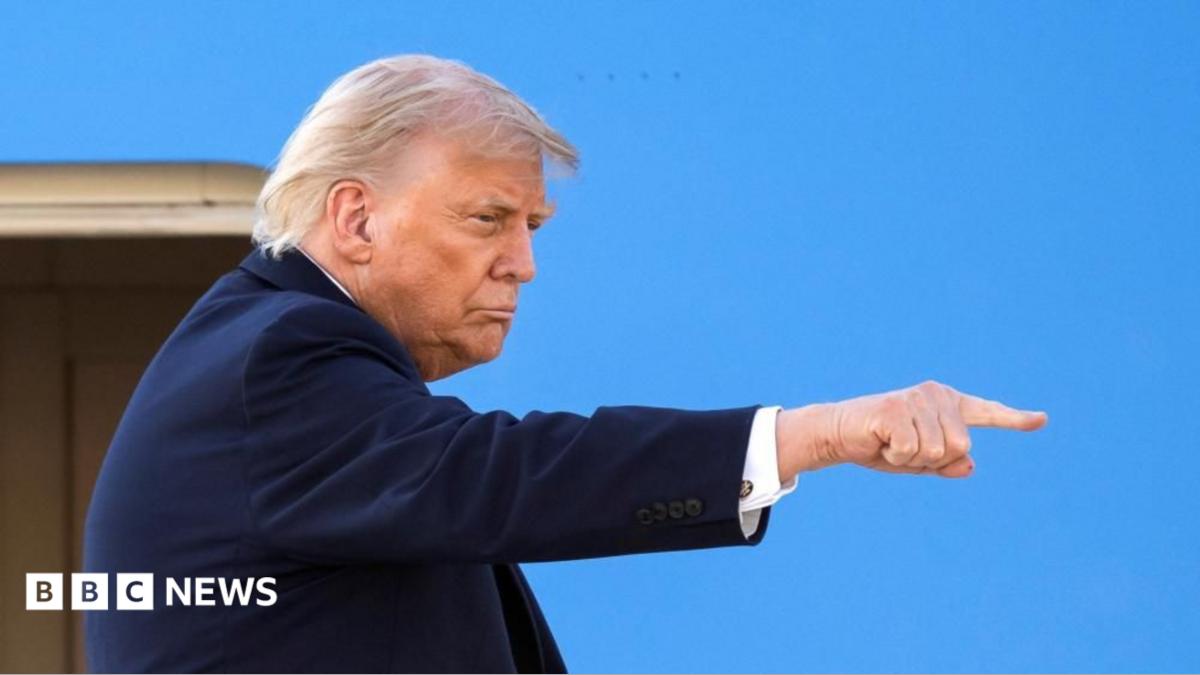
US President Donald Trump confirmed on Tuesday that he secretly boarded a different military aircraft when departing Turkey on 8 July after attending a NATO summit in Ankara, following what officials described as a credible Iranian threat to shoot down Air Force One. The operation, which involved transporting Trump to and from aircraft inside a catering truck, was first reported by the Washington Post on Monday before Trump acknowledged the switch to reporters.
Trump told reporters he had little choice in the matter, saying the Secret Service and military wanted him on a different aircraft. 'I just have to do what they say,' he said. He added that he had not inquired deeply into the nature of the threat: 'I guess there was a threat out there. I didn't really ask too much about it. I get a lot of threats.'
Officials told CBS News, the BBC's US partner, that the US had detected a credible Iranian threat to fire a missile at the plane. The White House has provided little additional detail about the specific intelligence.
According to multiple sources, Trump was seen boarding the older Air Force One 747 in view of television cameras before covertly departing on a separate military aircraft. Before leaving Ankara, Trump had posted on his Truth Social platform that he would use the older aircraft 'for old time's sake' to travel to RAF Mildenhall in Britain, while the newer Qatari-donated jet — which had been used for the NATO trip — would stop at the same base so US service members could tour it.
The military aircraft carrying Trump used the call sign 'Reach 18,' according to BBC News, while the plane carrying journalists continued to use the 'AF1' call sign as part of the deception. Journalists and some White House staff on board the decoy plane were not aware that Trump had left.
Reporters on the decoy aircraft were advised to keep their window shades closed during the flight. When later asked by reporters why the shades had to remain shut, Trump said it was because they were 'probably on a dangerous flight,' adding: 'But if I go, you go. Right?'
Trump flew first to RAF Mildenhall in Britain, where he was seen descending from the older Air Force One. According to BBC News, it is unclear how he transferred from the military C-32A back to that aircraft. He then boarded the new Qatari-donated Air Force One to return to Washington, during which he spoke to reporters about Iranian threats but did not mention the earlier plane switch.
Trump maintained on Tuesday that the military jet he actually boarded was at 'greater risk' than the decoy, and he downplayed the danger faced by those left on the Air Force One 747.
Government security experts, according to BBC News, have said such protective measures are not unusual when a president travels in or near a warzone, though past presidents who travelled covertly to places such as Afghanistan, Iraq, and Ukraine did so with at least some prior knowledge by media outlets under agreements not to disclose the movement until after the fact.
Jose Zamora, regional director for the Americas for the Committee to Protect Journalists, said in a statement that the Trump administration 'has a responsibility to ensure that journalists covering the president are not unnecessarily exposed to danger,' adding that reporters should be informed of credible security threats so they can make informed decisions about their own safety.
Iranian threats against Trump have a documented history. Following the January 2020 US strike that killed IRGC commander Qasem Soleimani, Iranian leaders promised reprisals. In July 2024, a Pakistani man, Asif Merchant, was arrested on allegations of ties to the IRGC and plotting to kill Trump; he was convicted in March 2026, according to BBC News. Separately, an Afghan citizen, Farhad Shakeri, was charged with another alleged assassination scheme and, according to BBC News, remains at large.
Trump has previously described himself as Iran's 'number one target.' According to BBC News, Defence Secretary Pete Hegseth said in March that 'Iran tried to kill President Trump,' noting that an unnamed Iranian who he said led an assassination unit had been killed in US strikes.
According to BBC News, the operation took more than a month to become public. The outlet noted that the prolonged secrecy may have been intended, in part, to avoid undermining Trump's public image of strength, given his repeated assertions that Iran has been thoroughly defeated militarily.
Where sources differ
- BBC News reports that Trump said the military jet he boarded was at 'greater risk' than the decoy plane; CBC News reports Trump downplayed the risk to those left on the decoy plane, saying he 'insisted' the threat 'didn't scare him.' The two characterisations are not directly contradictory but frame Trump's comments differently.
- CBC News attributes the initial detailed reporting of the plane switch to the Washington Post, citing unnamed sources; BBC News does not name the Washington Post as the originating outlet, referring more broadly to prior reports.
- The specific intelligence behind the reported Iranian missile threat has not been publicly detailed by the White House.
- It is not established how Trump transferred from the C-32A military aircraft back to the older Air Force One at RAF Mildenhall.
- Iran has not been reported in any of the sources as having commented on the alleged threat or the incident.
- The White House has not confirmed or denied whether those on the decoy plane were formally notified of any danger before or after the flight.
- It is not established what security arrangements, if any, were made for the journalists and White House staff travelling on the decoy aircraft.
- The sources do not establish whether any formal inquiry or review was initiated following the incident.
- BBC News — original — by Sareen Habeshian
- CBC News
- BBC News — by Anthony Zurcher