AI-written summary of reporting by Deutsche Welle. No human editor reviewed this. AI can misread or omit facts — read the original, linked below.
ABSTRACT
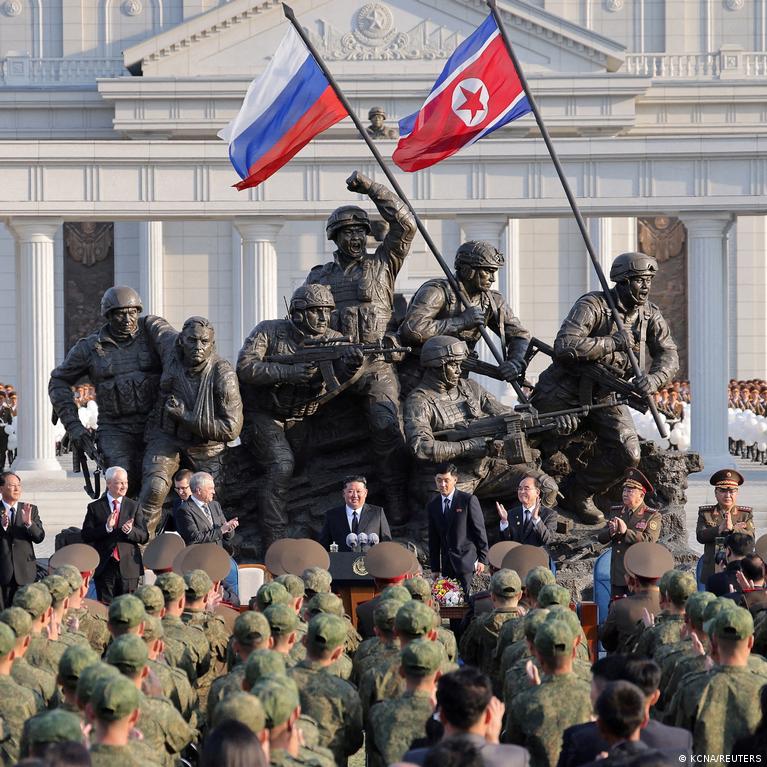
Ukrainian and international intelligence agencies suspect North Korea is planning to send an additional 30,000 to 50,000 troops to Russia, following an initial deployment of an estimated 14,000 to 15,000 soldiers to the Kursk region in late 2024, according to DW reporting. Ukrainian President Volodymyr Zelenskyy has raised concerns that North Korea's growing combat and weapons experience poses a security threat to Ukraine and the Asia-Pacific region.
Deutsche Welle
North Korea plans to send up to 50,000 more troops to Russia, Ukrainian and international intelligence agencies suspect
Aug 16, 2026, 2:49 AM
Ukrainian and international intelligence agencies suspect North Korea is planning to send an additional 30,000 to 50,000 troops to Russia, following an initial deployment of an estimated 14,000 to 15,000 soldiers to the Kursk region in late 2024, according to DW reporting. Ukrainian President Volodymyr Zelenskyy has raised concerns that North Korea's growing combat and weapons experience poses a security threat to Ukraine and the Asia-Pacific region.
Context
Ukraine's Main Directorate of Intelligence (HUR) states that North Korea has delivered 148 KN-23 and KN-24 short- and medium-range ballistic missiles to Russia since 2025. The HUR recently reported that a North Korean missile unit was deploying to Russia's Voronezh region, where it could be equipped with 120 ballistic missiles.
In July, Zelenskyy said a North Korean missile had struck a home near Ukraine's Kryvyi Rih, killing two parents and three children. Ukrainian military sources describe North Korean missiles as similar to Russia's Iskander missiles but with a greater payload, longer range, and lower accuracy.
KN-23 and KN-24 missiles, like Russia's Iskander 9M723, can reportedly only be intercepted by US-made Patriot air-defense systems, which Ukraine has run critically low on, according to the source.
Economist Janis Kluge of the German Institute for International and Security Affairs (SWP) wrote in a recent report that while Russia's recruitment campaign has shown signs of strain, regional spending figures indicate Russia is still recruiting around 1,000 contract soldiers each day.
All Perspectives
Oleksandr Kovalenko, Ukrainian Center for Security Studies: Kovalenko told DW that new North Korean troops would likely be used to secure Russia's border territories, including Kursk and possibly southwestern Voronezh. 'These forces could free up Russian occupational forces,' he said. 'Russia would then be able to deploy around 15,000 troops to battles along front lines in Vovchansk, Kharkiv, Sumy or even Chernihiv.' He does not expect North Korean troops to fight on Ukrainian territory. On missiles, he said he believes Russia is looking to launch a higher number not because reserves are depleted but 'to spread more terror.' He does not expect Russia to make substantial territorial gains along the front lines but warned that 'October, November and December could become very trying for Ukraine.'
Ruslan Leviev, Russian military analyst: Leviev told DW he had not seen concrete evidence of a noteworthy North Korean troop presence in Russia and said Moscow had enough troops available without drawing in foreign soldiers. 'If you look at the front line, you can see that Russia's forces have been fairly active since mid-July,' he said. 'That's a clear sign they still have enough forces.' On the question of North Korean troops fighting on Ukrainian soil, he said: 'It's one thing to recapture Russian territory, and an entirely different thing to be present on internationally recognized Ukrainian territory, taking part in a war of aggression. Diplomatically speaking, those are two entirely different concepts.' He said ballistic missiles would play a key role in this phase of the war, and that this summer he had seen Russia launch far more ballistic missiles than in previous years. Should Russia's supply run low by winter, he said, 'there will still be North Korea reserves, to make sure Ukraine cannot catch its breath.'
Yuri Fyodorov, military expert: Fyodorov called North Korea's missiles 'instruments of terror,' telling DW that 'it is very difficult to hit a small target with North Korean weapons.' He said he believed Russia had deliberately targeted residential areas with these missiles. On the broader trajectory, he said that a combination of a possible new Russian military call-up, fighters freed by North Korean replacements, and additional ballistic missiles 'would be no good for the course of the war, and for Ukraine's war interests.'
Jenny Town, Foreign Policy Research Institute (US): Town said the time had passed for North Korea's involvement to make a significant difference to the war's outcome. She said Russia and North Korea had instead established a mutually beneficial partnership that is only likely to deepen through the course of the war with Ukraine.
President Volodymyr Zelenskyy, Ukraine: Zelenskyy raised concerns that North Korea's improved combat and weapons experience could pose a security threat to Ukraine as well as the Asia-Pacific region. He cited the deployment of a North Korean missile unit to Russia's Voronezh region as indication that Russia's strategic missile reserve is depleted.
Position not represented in the source reporting: Russia; North Korea.
Gaps & Unknowns
- The source does not state which specific Ukrainian or international intelligence agencies assessed the 30,000–50,000 additional troop figure, or the evidentiary basis for that estimate.
- The source does not state Russia's official position on the reported North Korean troop deployments or missile transfers.
- The source does not state North Korea's official position on its military involvement in Russia.
- The source does not specify the exact date on which the HUR reported the North Korean missile unit deploying to the Voronezh region.
- The source does not establish whether the 148 missiles delivered since 2025 have all been fired or how many remain in inventory.
- The source does not state the current number of Patriot air-defense interceptors Ukraine holds or a precise definition of 'critically low.'
Sources & Further Reading
- Deutsche Welle — original
Read the original at Deutsche Welle
Related Coverage