Russia's Supreme Court on Monday ruled to bar Yabloko, the country's only registered anti-war opposition party, from the parliamentary elections scheduled for September 18–20, following a lawsuit that alleged the party infringed copyright in its campaign materials, engaged in extremist activities, and received illegal financing from abroad. Party leader Nikolai Rybakov said he would appeal the verdict and remain in Russia.
Russia's Supreme Court bars Yabloko from September parliamentary elections
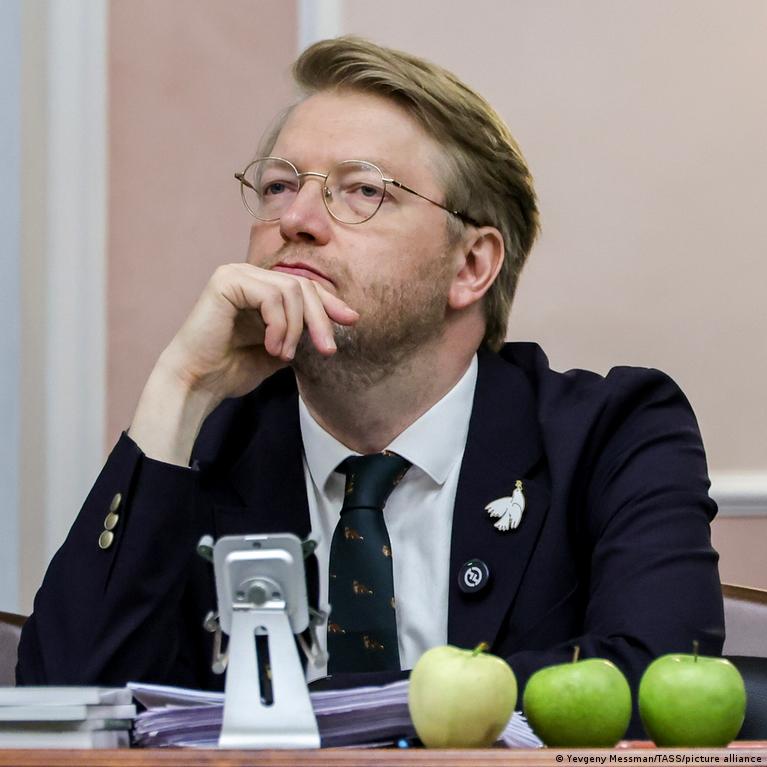
Russia's Supreme Court on Monday ruled to bar Yabloko, the country's only registered anti-war opposition party, from the parliamentary elections scheduled for September 18–20, following a lawsuit that alleged the party infringed copyright in its campaign materials, engaged in extremist activities, and received illegal financing from abroad. Party leader Nikolai Rybakov said he would appeal the verdict and remain in Russia.
The lawsuit was brought by the pro-Kremlin party Rodina, according to Deutsche Welle. The verdict was delivered by presiding judge Vyacheslav Kirillov, who, according to DW, is the same judge who banned the Russian human rights organisation Memorial and designated it extremist in April, and who previously dismissed legal complaints against the Russian prison service filed by opposition politician Alexei Navalny.
Yabloko denied all the charges against it. Rybakov wrote on Telegram that the party had not broken any Russian laws and announced the appeal. According to The Straits Times, after the verdict was read, hundreds of supporters outside the court chanted 'Shame!' loudly enough to be heard inside the building.
According to DW, at least 500 people gathered in front of the Supreme Court during the nine-hour session, distributing apples and singing songs. At the session's conclusion, security services reportedly threatened those assembled with arrest and warned young men they could be taken to an army enlistment office.
Yabloko holds only a handful of regional seats and has no representation in the State Duma, the lower house of parliament, which is dominated by the Putin-backed United Russia party, according to The Straits Times. The September vote will elect members to the 450-seat lower house.
Rybakov told Reuters that the court's decision reflected authorities' concern that Yabloko's call to end the war in Ukraine was resonating with voters. 'For us, the support of the people that exists now, which is completely obvious and impossible to hide, is far more important than the court's decision,' he said.
Rybakov, 47, said he had no plans to leave Russia despite censorship laws and wartime legislation that have prompted many opposition figures and activists to flee or face prosecution. 'I am in Russia and will remain in Russia,' he said, according to The Straits Times. 'It is only possible to change what is happening in Russia, to change the political situation in Russia, by being inside the country.'
According to The Straits Times, the share of Russians who say they support the actions of their armed forces in Ukraine fell to 66% in July, the lowest level since February 2022, according to the Levada Center, a non-governmental pollster listed by Moscow as a foreign agent.
Grigory Yavlinsky, one of Yabloko's founders, said those in power were afraid of the party's programme, arguing that 'removing a party with a platform like this from the election, without any real grounds, is the political system exposing itself,' according to DW.
Yulia Navalnaya, widow of Alexei Navalny and leader of the Anti-Corruption Foundation he founded, said on Telegram that the Kremlin had originally intended to allow Yabloko to stand but 'got scared' and had the party blocked. She wrote that authorities had observed people beginning to join forces — less about support for Yabloko specifically than the opportunity for millions of Russians to express their views on Vladimir Putin and the war, according to DW.
Andrei Pivovarov, a political activist based in exile in Germany and coordinator of the Russian Antiwar Committee, told DW that opposition supporters had not expected supporting Yabloko to bring swift political change or end the war. The aim, he said, was to make visible the extent of anti-war sentiment in Russia. 'There would have been a dozen parties on the ballot who are pro-war, and one that is pro-peace. The war wouldn't end even if Yabloko were to get representatives into the State Duma. But we would have seen that a lot of Russians oppose the war,' he said.
Political scientist Ivan Preobrazhensky, speaking to DW, speculated that the banning of Yabloko could reflect a power struggle within the Kremlin — either the FSB-aligned security bloc wanting Yabloko to act as a counterweight to the New People party, or presidential administration figure Sergey Kiriyenko having misjudged the potential of anti-war sentiment in the country.
The lawsuit coincided with an appeal by Russian opposition and cultural figures living abroad — including Navalnaya, Lyubov Sobol, Ilya Yashin, Pivovarov, writer Dmitry Bykov, and human rights activist Oleg Orlov — calling on people to support Yabloko, according to DW.
Where sources differ
- On the size of the crowd outside the Supreme Court: The Straits Times reports 'hundreds' of supporters chanting outside; DW reports 'at least 500 people' gathered in front of the court.
- The Kremlin has not been quoted or reported as responding directly to the court ruling or to characterisations that it 'got scared' of Yabloko.
- The pro-Kremlin party Rodina, which brought the lawsuit, is not quoted or given a chance to elaborate on its specific allegations in either source.
- Judge Vyacheslav Kirillov's reasoning in the verdict is not detailed in either source.
- The specific copyright materials alleged to have been infringed are not identified.
- The outcome of Yabloko's planned appeal is not known.
- The sources do not establish how many signatures or formal members Yabloko's recent manifesto attracted.
- Neither source clarifies the precise legal basis under which the foreign financing allegation was made or what evidence was presented.
- The position of the New People party, mentioned in connection with Kremlin internal dynamics, is not reported.
- The Straits Times — original — by The Straits Times
- Deutsche Welle — by Evgeniy Dyuk
Read the original at The Straits Times