Russian President Vladimir Putin visited the disputed Kuril Islands on Thursday for the first time, touring the island of Iturup — known in Japan as Etorofu — where he visited a fish-processing plant, a hospital and a school, and met briefly with local residents and the governor of Russia's Sakhalin region, Valery Limarenko, according to the Associated Press. The visit drew formal protests from Japan, which claims the four southernmost islands of the chain under the name Northern Territories.
Putin visits Kuril Islands for first time, prompting protests from Tokyo
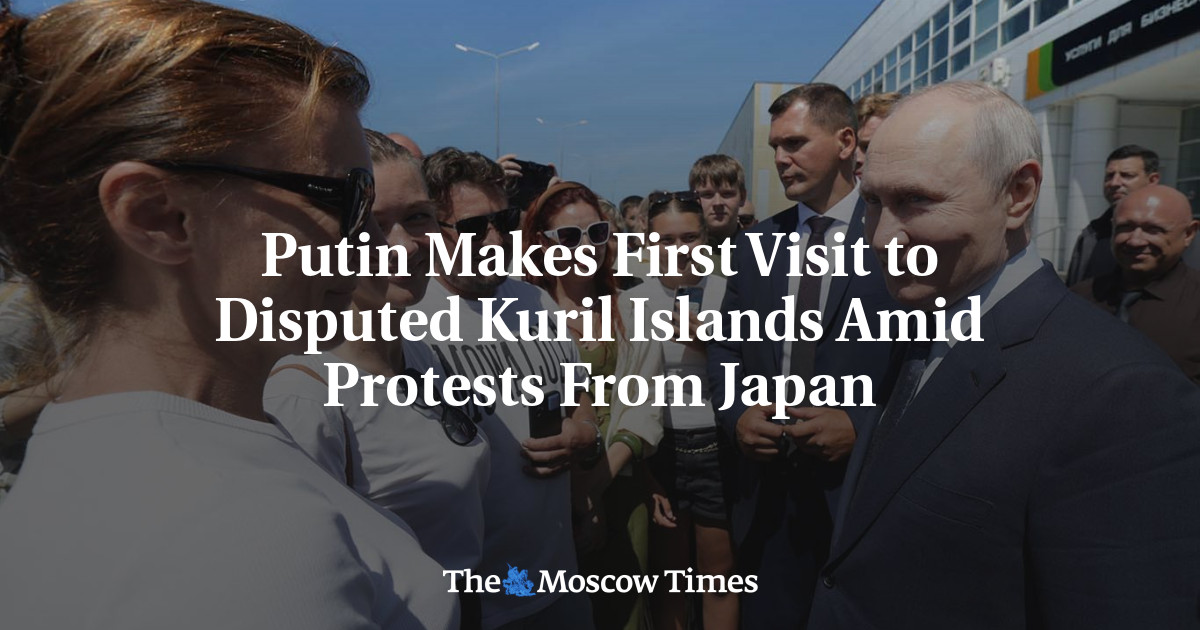
Russian President Vladimir Putin visited the disputed Kuril Islands on Thursday for the first time, touring the island of Iturup — known in Japan as Etorofu — where he visited a fish-processing plant, a hospital and a school, and met briefly with local residents and the governor of Russia's Sakhalin region, Valery Limarenko, according to the Associated Press. The visit drew formal protests from Japan, which claims the four southernmost islands of the chain under the name Northern Territories.
The Soviet Union seized the volcanic archipelago, which runs in a broad arc from Russia's Kamchatka peninsula to Japan's northern island of Hokkaido, in the final days of World War II in 1945. The dispute over the four contested islands — known in Russian as Kunashir, Habomai, Shikotan and Iturup, and in Japanese as Kunashiri, Habomai, Shikotan and Etorofu — has prevented Moscow and Tokyo from signing a formal peace treaty ending hostilities from that war.
Decades of diplomatic efforts to reach a settlement have produced no visible results, according to the AP. Russia has over the years increased its military presence on the islands. The roughly 20,000 Russian citizens who live there do so in a harsh climate, though the islands hold mineral deposits including gold and silver, as well as rich fishing grounds. After occupying the islands in 1945, Moscow deported their Japanese population of approximately 17,000 people.
Putin travelled to the Kurils after visiting the nearby Russian island of Sakhalin on Wednesday, where Russia's navy was conducting drills. In Sakhalin, Putin held a meeting described by Russian media outlet RIA Novosti, as cited by The Moscow Times, as being 'on ensuring the security of Russia's eastern borders.'
According to The Moscow Times, then-President Dmitry Medvedev became the first Russian leader to visit the disputed territory in 2010, and subsequently returned several times as prime minister. The AP noted that Japan also protested a 2021 visit by Prime Minister Mikhail Mishustin to Iturup.
Relations between Japan and Russia have deteriorated since Russia's full-scale military operations in Ukraine began in 2022. Japan has joined other G7 nations in imposing sanctions on Russia and has provided financial and non-lethal aid to Kyiv. Putin on Wednesday described Japan's sanctions as 'unprovoked.' Russia and China have also conducted joint naval and air exercises in areas around Japan, prompting frequent responses from Japanese fighter jets, according to The Moscow Times. North Korea, according to the same source, has sent troops and artillery shells to support Russia's military campaign in Ukraine.
According to The Moscow Times, Japan's latest defense white paper, issued this month, again highlighted growing risks from Russia, China and North Korea. The Moscow Times also reported that The New York Times reported in July that Russia had turned Japan into a key source of dual-use technology for its war in Ukraine, though that claim does not appear in the other sources.
Where sources differ
- The Moscow Times attributes the statement that the Northern Territories 'are an inherent part of Japan's territory, both historically and under international law' to Prime Minister Sanae Takaichi. Al Jazeera and the AP attribute similar wording to Foreign Minister Toshimitsu Motegi. All three sources agree both officials made statements condemning the visit, but differ on which official used that specific formulation.
- The Moscow Times reports that Putin met 'residents' on Iturup; the AP specifies he 'briefly spoke to local residents and met with the governor of Russia's Sakhalin region, Valery Limarenko'; Al Jazeera says he met 'with the regional governor' but does not name him. The AP is the only source to name the governor.
- No source provides an official Russian government statement specifically justifying or explaining the timing or purpose of Putin's visit to the Kurils beyond the general itinerary details.
- None of the sources establishes whether Putin made any public remarks while on Iturup itself, as distinct from his Wednesday statements on Sakhalin.
- The sources do not clarify whether Japan summoned the Russian ambassador or took any diplomatic action beyond issuing statements.
- The longer-term diplomatic or legal consequences of the visit are not established by any source.
- The Moscow Times' reference to a New York Times report about Russia using Japan as a source of dual-use technology is not corroborated by the other two sources.
- The sources do not indicate whether the Kremlin offered any response to Japan's specific protests following the visit.
Read the original at The Moscow Times