NASA's Nancy Grace Roman Space Telescope lifted off at 7:26 a.m. ET on Sunday from Launch Complex 39A at the Kennedy Space Center in Cape Canaveral, Florida, carried atop a SpaceX Falcon Heavy rocket. The observatory, which carries a price tag reported by multiple sources as approximately $4 billion — though CBS News and NBC Connecticut cite $4.3 billion — separated from the rocket 31 minutes and 41 seconds after liftoff and began a journey of roughly one million miles to its permanent home at the second Sun-Earth Lagrange Point, known as L2, a gravitational balance point where the James Webb Space Telescope already operates.
NASA launches Nancy Grace Roman Space Telescope aboard SpaceX Falcon Heavy from Kennedy Space Center
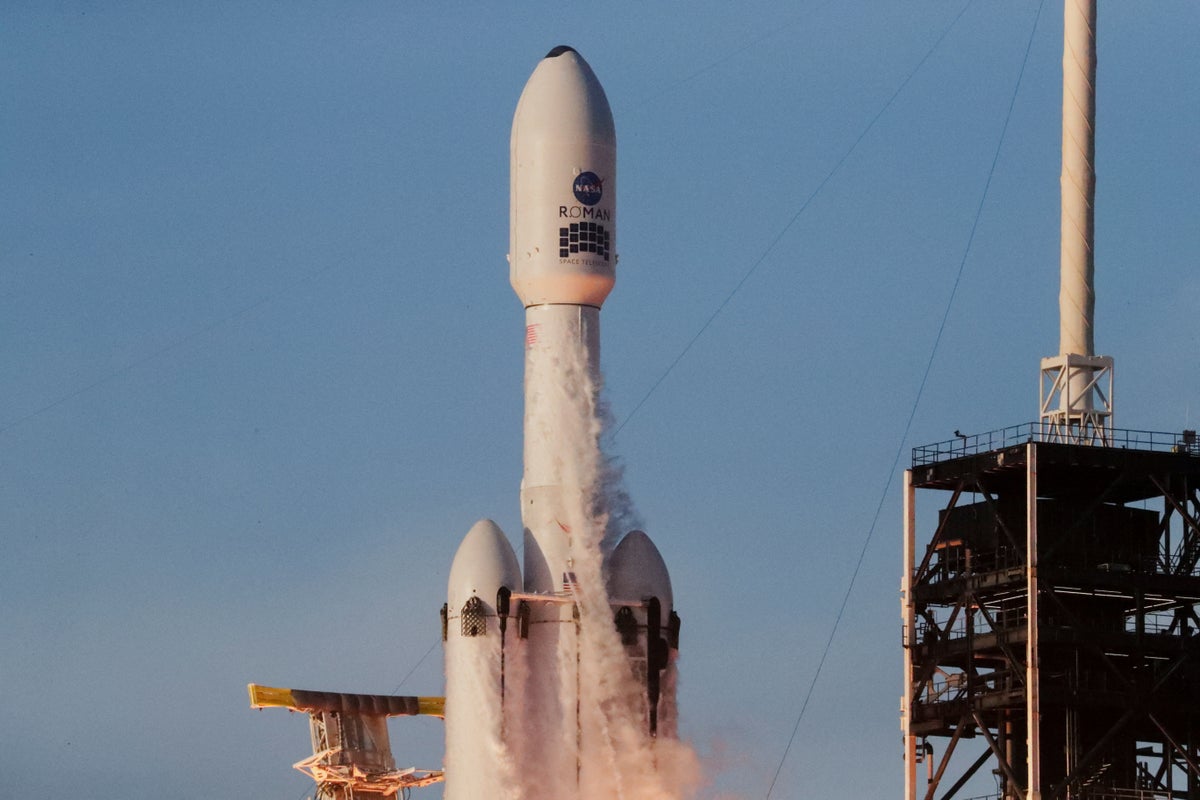
NASA's Nancy Grace Roman Space Telescope lifted off at 7:26 a.m. ET on Sunday from Launch Complex 39A at the Kennedy Space Center in Cape Canaveral, Florida, carried atop a SpaceX Falcon Heavy rocket. The observatory, which carries a price tag reported by multiple sources as approximately $4 billion — though CBS News and NBC Connecticut cite $4.3 billion — separated from the rocket 31 minutes and 41 seconds after liftoff and began a journey of roughly one million miles to its permanent home at the second Sun-Earth Lagrange Point, known as L2, a gravitational balance point where the James Webb Space Telescope already operates.
The Falcon Heavy's two side booster cores separated approximately two and a half minutes after liftoff and returned to on-target landings at Cape Canaveral Space Force Station, according to CBS News. The central core stage was expended in the Atlantic Ocean after using its propellant to maximize performance. The second stage fired twice to reach the required trajectory before releasing the 18,000-pound spacecraft.
According to NBC Connecticut, the rocket reached the speed of sound within one minute and crossed the boundary of space — 62 miles above sea level — in under five minutes. Shortly after separation, the telescope's solar panels and other instruments began deploying, with NASA's Goddard Space Flight Center receiving nominal telemetry data, NASA administrator Jared Isaacman confirmed.
The telescope is expected to take approximately 100 days to reach L2, located about one million miles — or 1.6 million kilometers — from Earth. During that transit, engineers will spend roughly 90 days commissioning the spacecraft and conducting calibrations. The first high-resolution science images are expected before the end of 2026, according to project manager Jackie Townsend, while Deutsche Welle reported that first images are expected in early 2027.
The Roman telescope has an unusual origin: it was originally designed for a spy satellite program operated by the National Reconnaissance Office, a U.S. intelligence community agency. That program was terminated over budget, and the NRO donated the hardware to NASA in 2012, which repurposed it for astronomical science, according to The Independent and NPR.
The observatory is named after Nancy Grace Roman, who became NASA's first Chief of Astronomy in 1959, according to NBC Connecticut, and served throughout the 1960s and 1970s, according to Deutsche Welle. She was born in 1925 and died in 2018. Roman was instrumental in securing congressional approval for the Hubble Space Telescope, earning her the informal title 'Mother of the Hubble Space Telescope.' NASA named the new observatory after her in 2020. Deutsche Welle noted it is NASA's first space telescope named after a woman.
Roman carries a 300-megapixel wide-field camera and, according to CBS News, a second experimental coronagraph instrument equipped with shape-shifting mirrors capable of dimming the light of distant stars to allow analysis of the reflected light from Jupiter-size planets orbiting them. The main camera can survey the sky at least 1,000 times faster than Hubble, with each image covering a patch of sky at least 100 times larger, according to NBC Connecticut and NPR.
Senior project scientist Julie McEnery described Roman's survey capability by saying one month of observations could cover the entire Milky Way galaxy — a task that would take Hubble roughly a century. NASA science mission director Nicky Fox said the telescope 'is going to find thousands of supernovae, tens of thousands of planets, billions of galaxies and tens of billions of stars,' adding that 'it's going to be able to do things that we've never been able to do before with its massive field of view.'
Roman's primary science goals center on mapping dark matter and dark energy. Dark energy, the hypothesized repulsive force accelerating cosmic expansion, is thought to represent approximately 68 percent of the universe's total contents; dark matter, which is inferred through its gravitational effects on galaxies and stars, is thought to represent about 27 percent; and ordinary matter accounts for approximately 5 percent. Roman will create what NASA describes as the most comprehensive three-dimensional map of the universe to date, covering more than two billion galaxies during its main survey, which is expected to take more than a year.
The telescope will also conduct one of the most extensive searches ever for exoplanets. More than 6,000 have been confirmed to date, according to CBS News and NPR. By the end of its mission, Roman is expected to identify more than 100,000 additional exoplanets — through both the transit method, in which the telescope detects dips in starlight as a planet crosses in front of its star, and through microlensing, which detects gravitational distortions of background starlight. NPR reported that approximately 1,000 additional discoveries are expected through microlensing specifically.
CBS News reported that Roman will also catalog approximately 20 billion stars, 2 billion or more individual galaxies, and tens of thousands of supernova events over the course of its mission. Scientists expect the telescope to generate more than 500 terabytes of data per year, according to Deutsche Welle. NPR reported that the daily raw data output will be 1.4 terabytes, while The Straits Times cited a figure of approximately 1.3 terabytes per day. NASA plans to make all data publicly available through a cloud-based system called Roman Nexus, according to NPR.
Cosmologist Mustapha Ishak of the University of Texas at Dallas, a member of Roman's scientific collaboration, told Reuters — as reported by France 24 — that 'historically, major astronomical observatories have often made their most important breakthroughs in areas that scientists did not anticipate before launch.' Senior project scientist McEnery said at a pre-launch briefing that recent observations 'hint that our standard model of the universe is incorrect,' and that Roman's data will either confirm or refute the existing model with sufficient precision to guide future research, according to The Straits Times.
Roman is designed to complement, rather than replace, existing observatories. Multiple sources quoted NASA officials comparing the relationship between Roman and Webb to that of a wide-angle camera lens and a zoom lens respectively. The Straits Times also noted that Roman's observations will complement the work of the Rubin Observatory in Chile and the European Space Agency's Euclid probe.
NASA administrator Jared Isaacman said at the post-launch news conference that Roman 'will become a household name alongside' Hubble and the James Webb Space Telescope. During that same briefing, President Donald Trump called Isaacman by phone and the administrator held his phone to a microphone so Trump could address the room. 'Boy, it looked beautiful on television,' Trump said, adding, 'You are doing a fantastic job, and I'm supplying you all that money.' Isaacman replied that there were 'a lot of smiling people in the room right now.'
Trump's administration sought during both his first and second terms to cut or eliminate Roman's funding, but Congress preserved the program in both instances, according to multiple sources. The Independent noted that NASA's approximately $24 billion fiscal year 2026 budget survived an earlier White House proposal to reduce the agency's funding by about $6 billion. The launch occurred nine months ahead of its previously scheduled date, which multiple sources described as a notable achievement for a flagship NASA mission, given that the project team also navigated the COVID-19 pandemic and government shutdowns.
The primary mission is planned for five years, though NASA indicated the spacecraft may carry enough propellant to operate for a further five years.
Where sources differ
- Total mission cost: The Independent, France 24, Deutsche Welle, and The Straits Times report the cost as 'roughly $4 billion' or 'more than $4 billion,' while CBS News and NBC Connecticut each cite a figure of $4.3 billion.
- Daily data output: NPR reports Roman will beam back 1.4 terabytes of raw science data each day, while The Straits Times cites approximately 1.3 terabytes per day.
- Timing of first images: The Independent reports the first high-resolution images are expected 'before the winter holidays' (i.e., late 2026), while Deutsche Welle reports they are expected in early 2027.
- Nancy Grace Roman's tenure as NASA Chief of Astronomy: NBC Connecticut states she became NASA's first chief of astronomy in 1959; Deutsche Welle says she served 'throughout the 1960s and 1970s.' The sources are not necessarily contradictory but describe the role differently.
- Travel time to L2: Deutsche Welle states the telescope will reach its destination in 'approximately one month,' while multiple other sources, including CBS News, NPR, and The Straits Times, report the journey will take approximately 100 days (about three months). The Straits Times and CBS News both cite 100 days explicitly.
- No source establishes the full year-by-year science observing schedule beyond the three primary survey categories described.
- No source provides detail on what specific configuration changes or modifications NASA made to the NRO-donated hardware when repurposing it for astronomical use.
- The sources do not clarify whether the coronagraph instrument is considered part of the primary or secondary mission objectives, or what its official operational status is at launch.
- No source explains the precise methodology by which the launch came to be nine months ahead of schedule, beyond noting that teams navigated COVID-19 and government shutdowns.
- The discrepancy between Deutsche Welle's reported travel time of 'approximately one month' versus other sources' figure of approximately 100 days is not explained or reconciled in any source.
- No source provides comment from SpaceX on the mission beyond describing rocket performance.
- No source details what conditions or criteria would trigger an extension of the mission beyond the initial five-year primary phase.
- The European Space Agency, whose Euclid probe is mentioned as a complementary mission, is not quoted or given an opportunity to respond in any source.
- The Independent — original — by Joey Roulette and Will Dunham
- NBC Connecticut — by Denise Chow | NBC News
- Deutsche Welle — by Matt Ford
- CBS News — by William Harwood
- NPR News — by Brendan Byrne
- France 24 — by FRANCE 24
- The Straits Times — by The Straits Times
Read the original at The Independent