A wheel prototype built by Australian mechanical engineer Daniel Bloomfield and his son Isaac Bloomfield won NASA's Rock and Roll with NASA Challenge, a public competition to design next-generation lunar rover wheels, following prototype testing on July 31 at NASA's Johnson Space Center in Houston.
Australian team wins NASA lunar wheel design competition after testing at Johnson Space Center
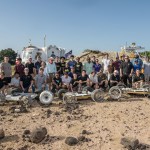
A wheel prototype built by Australian mechanical engineer Daniel Bloomfield and his son Isaac Bloomfield won NASA's Rock and Roll with NASA Challenge, a public competition to design next-generation lunar rover wheels, following prototype testing on July 31 at NASA's Johnson Space Center in Houston.
The challenge drew 128 submissions from 49 countries. Five teams advanced to the final phase, where their wheels were fitted to MicroChariot, a 45-kilogram test rover, and evaluated across different terrain types at Johnson's Rock Yard.
The winning Scotch Pad Tyres design uses a Nomex-based tire structure supported around an aluminum hub. The soft material allows the tire to deform around terrain while internal support helps it maintain its shape, and a treated outer surface of epoxy and corundum grit was added to improve traction.
The four other finalist designs each used distinct engineering approaches. The HTR Variable Flex Lunar Wheel, made by Hellenic Technology of Robotics SA, uses an internal system to vary wheel stiffness depending on terrain, adapted from about a decade of terrestrial wheel development. The Hiper Wheel by Hyperbola relies on tensioned cables and a corrugated structure for spring-like flex without traditional radial spokes. The Huff Helo Flexible Titanium Wheel by Huff Helo Inc. uses formed titanium sheet metal as both structure and spring, though testers found the design's strength made it more rigid, causing it to bounce over some obstacles. The Payne Aviation Wheel, created by Deborah and Craige Payne, combined a pneumatic approach with ideas from early automobile tire designs, with its designer drawing on a background in aircraft mechanics.
NASA Johnson uses ground prototypes to test mobility technologies. Lunar terrain vehicles are delivered to the lunar surface through the agency's Commercial Lunar Payload Services initiative. The Rock and Roll with NASA Challenge was conducted by the Common Robotics Project of the Robotic Systems Technology Branch within Johnson's Engineering Directorate. NASA's Center of Excellence for Collaborative Innovation managed the challenge contract, and HeroX administered it on behalf of NASA. Students in NASA's Robotics Academy helped prepare hardware and support the competition, while engineers from NASA's Glenn Research Center in Cleveland supported reviews of concepts and proposals.
- The source does not state the prize amount or other incentives awarded to the winning team.
- The source does not state whether any of the five finalist designs will be formally adopted or advanced by NASA for an actual lunar mission.
- The source does not state a timeline for the potential next phase of testing in Johnson's thermal vacuum chambers.
- The source does not state the specific performance metrics or scoring criteria used to select the winning design over the other four finalists.
- The source does not state the nationality or organizational affiliation of the Hyperbola team behind the Hiper Wheel.