Italian Prime Minister Giorgia Meloni's government commands less than 30% of voting support among under-35s, compared with almost 50% for the opposition bloc, according to polling agency Youtrend — a gap that analysts say could prove significant at a national election expected in 2027.
Italian PM Meloni's support among under-35 voters falls sharply, polls show
Italian Prime Minister Giorgia Meloni's government commands less than 30% of voting support among under-35s, compared with almost 50% for the opposition bloc, according to polling agency Youtrend — a gap that analysts say could prove significant at a national election expected in 2027.
Meloni took office in 2022 leading a coalition that includes her Brothers of Italy party (FDI), Matteo Salvini's League, and Foreign Minister Antonio Tajani's Forza Italia. At the peak of her popularity in 2023, Youtrend polling showed FDI alone attracted roughly the same support among young people as the entire ruling coalition does now.
The opposition bloc, dominated by the Democratic Party (PD), the 5-Star Movement and the Left-Green Alliance (AVS), draws nearly 50% support among under-35s. The government's overall approval rating among under-35 voters stands at 25%, against 35% among the general population, according to Youtrend data.
Young Italians exhibit a gender divide similar to that seen elsewhere in Europe, according to a study by Milan's Bocconi University based on data from polling firm SWG. Support for FDI among 18- to 29-year-old men was recorded at 15%, compared with 4.2% among women in the same age group. 5-Star was backed by 18% of women under 30 and 5.1% of men.
Italy's employment rate among 15- to 24-year-olds is the lowest in the 21-nation euro zone, according to Eurostat data, and the country invests less in education than almost all other euro zone members. A young graduate in Germany earns on average 80% more than an Italian peer, according to the Bank of Italy, and tens of thousands of young Italians leave the country each year in search of better prospects abroad.
Meloni also faces competition for younger voters within her own ideological camp. National Future, a far-right opposition party formed in February by former army general Roberto Vannacci, is polling at about 7%. Surveys show its strongest support comes from middle-aged men, but Vannacci also has a following among anti-immigrant urban youths attracted by his pledge to return thousands of migrants to their countries of origin.
The government's law-and-order measures have included a crackdown on rave parties introduced in Meloni's first law decree, as well as subsequent steps targeting so-called 'light' cannabis production, disruptive street protests, squatters, and juvenile crime. A 2023 decree toughening sanctions for offending minors has already contributed to a 50% rise in the juvenile prison population, according to prisoners' rights group Antigone.
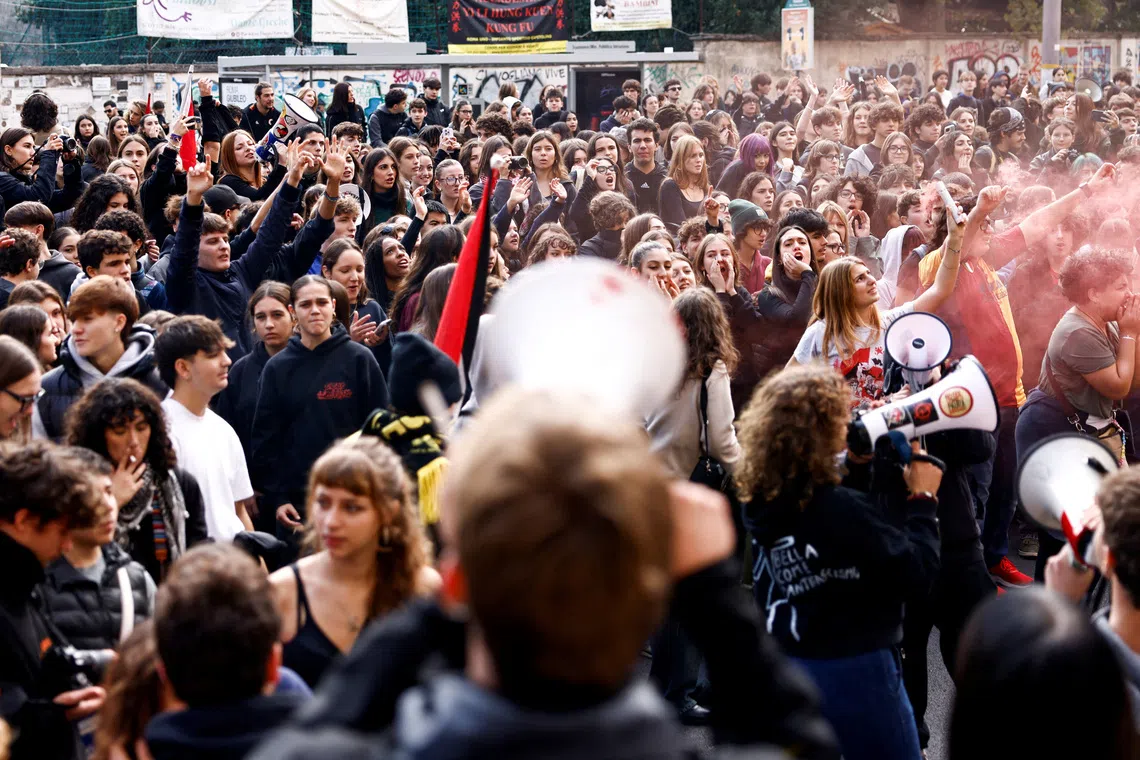
A nationwide student protest dubbed 'No Meloni Day' in November last year drew thousands marching against security decrees, education spending cuts, and Meloni's position on Gaza. Last month the government presented a bill to reverse the presumption of limited criminal responsibility for minors aged 14 to 17, requiring instead that innocence of full responsibility be proven rather than guilt.
A separate government measure requires written parental consent before minors can receive sex education in school.
At a March referendum on a justice system reform championed by Meloni, 67% of under-35s cast a ballot, with 60% of that group rejecting the reform. Overall turnout was 59%, with 54% voting against the measure. Days before the vote, Meloni appeared on a podcast hosted by a popular rapper in an effort to reach younger voters.
- No spokesperson or representative of the Meloni government provided a substantive response to the polling figures or the analysts' assessments.
- The specific methodology and sample sizes behind the Youtrend polling figures are not detailed.
- The Bocconi University and SWG study's methodology, sample size, and exact date of fieldwork are not specified beyond 'last year'.
- The article does not specify which justice system reform was the subject of the March referendum beyond describing it as championed by Meloni.
- The article does not detail what, if any, youth-focused policies Meloni's government has introduced since 2022.
- National Future party's full policy platform beyond migration is not described.
- The article does not state the precise date of the next general election, referring only to 2027.
Read the original at The Straits Times