More than half of India's data centers are situated in water-stressed regions, according to a report by the World Resources Institute India, as residents of Khora — a densely populated area of Ghaziabad on the outskirts of New Delhi — describe a decade-long struggle to secure reliable water access even as new data center facilities are built nearby.
Data centers in India's water-stressed regions raise supply concerns for residents
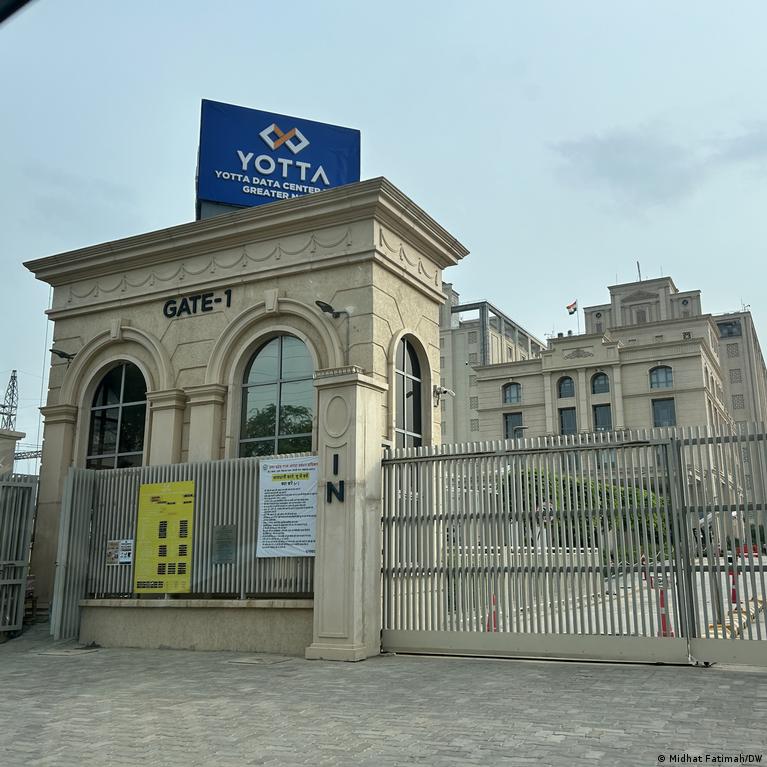
More than half of India's data centers are situated in water-stressed regions, according to a report by the World Resources Institute India, as residents of Khora — a densely populated area of Ghaziabad on the outskirts of New Delhi — describe a decade-long struggle to secure reliable water access even as new data center facilities are built nearby.
Residents of Khora say they depend entirely on groundwater, with boreholes in some parts of the area requiring drilling to depths of 305 to 366 meters. Deepak Joshi, president of the Khora Residents' Association, told DW that efforts to resolve the water situation had continued for ten years without result. He said each borewell costs around 500,000 rupees (approximately $5,250), which many families cannot afford, and that even boreholes offer no permanent guarantee as water levels can drop unpredictably. Some families have moved out of the area as a result, according to Joshi.
Carpenter Naeemuddin Saifi, a 35-year resident of Khora colony, said he does not own his own water connection and pays 1,000 to 1,200 rupees ($10.50–$12.50) per month for access to a shared borewell.
According to the Central Ground Water Board, Ghaziabad city's annual extractable groundwater resources stand at approximately 2,714 hectare metres, but actual extraction in 2024–2025 reached around 272 percent of that recommended level.
Ranjana Ray Chaudhuri, head of the Department of Natural and Applied Sciences at TERI University, said the Ghaziabad and Noida region was historically marketed as having abundant water from canals, rivers, and groundwater, but that rapid urbanization has altered that picture. She added that heat expelled by data center cooling systems can affect the local microclimate, potentially raising temperatures in surrounding buildings and increasing their air-conditioning and water demand. She cautioned, however, that there is not yet sufficient data to fully assess the local impact of large data centers.
India's total data center capacity grew from approximately 375 megawatts in 2020 to around 1,500 megawatts in 2025, a fourfold increase, according to the Ministry of Electronics and Information Technology. As of the time of reporting, 305 data centers operate across India, according to the Data Center Map. The facilities reportedly consumed around 150 million tons of water in the previous year, with some estimates projecting that figure could double by 2030.
In 2025, authorities cancelled a long-sought project that would have redirected Ganges water to Khora. A Ghaziabad Municipal Council executive officer told DW an alternative water project was under development, though Joshi said residents had received no information about it.
AdaniConnex, a 50:50 joint venture between India's Adani Group and US-based EdgeConneX, operates a data center a short distance from Khora. It is one of more than 20 such facilities in Noida, the industrial city adjacent to Ghaziabad. The Uttar Pradesh 2026 Data Center Policy Draft includes a government commitment to provide an 'uninterrupted 24x7' water supply to data centers in the state.
Prateek Aggarwal of the Council on Energy, Environment and Water (CEEW) said no official estimate exists for water consumed by data centers across the National Capital Region, and described water stress in Noida as particularly high given rapid urban growth and continued reliance on groundwater.
Gayatri Naik, co-director of the Center for Environmental Law, Education, Research and Advocacy at the National Law School of India University, described India's regulatory framework as fragmented. She said commercial entities must obtain a no-objection certificate to extract groundwater specifying permitted volumes, but are not generally required to publish regular figures on actual consumption. She contrasted this with EU rules, which require data centers to disclose water consumption and mandate that facilities with IT power capacity of at least 500 kilowatts report key sustainability data to a European database.
Aggarwal called for mandatory annual reporting of energy, water, and carbon use — including the source and recycling rate of water — along with phased efficiency standards and consideration of water availability in data center approval decisions. He said the primary strain in areas such as the National Capital Region arises from multiple facilities drawing on a shared aquifer rather than from any single project. Naik said the situation raises questions about distributional justice when drinking water needs and commercial extraction compete in water-scarce areas.
- AdaniConnex did not respond to DW's query; its actual water consumption figures are unknown.
- No official aggregate estimate exists for water consumed by data centers across the National Capital Region, according to the source.
- The nature and timeline of the alternative water project referenced by the Ghaziabad Municipal Council are not specified.
- The source does not identify which specific data centers are operating in Khora or detail their individual water use.
- The source does not include a response from the Uttar Pradesh state government regarding the tension between its data center water pledge and residential water shortages.
- The source does not include comment from India's Ministry of Electronics and Information Technology on water regulation or disclosure requirements.
Read the original at Deutsche Welle