William Thomson, an Irish-born Scottish mathematician and physicist who later became Lord Kelvin, developed a mirror galvanometer that could detect electrical signals too weak for conventional instruments to register, addressing a central problem in transmitting messages through long submarine telegraph cables, including the first durable transatlantic connection established in 1866.
Mirror galvanometer gave transatlantic telegraph a sensitive signal receiver
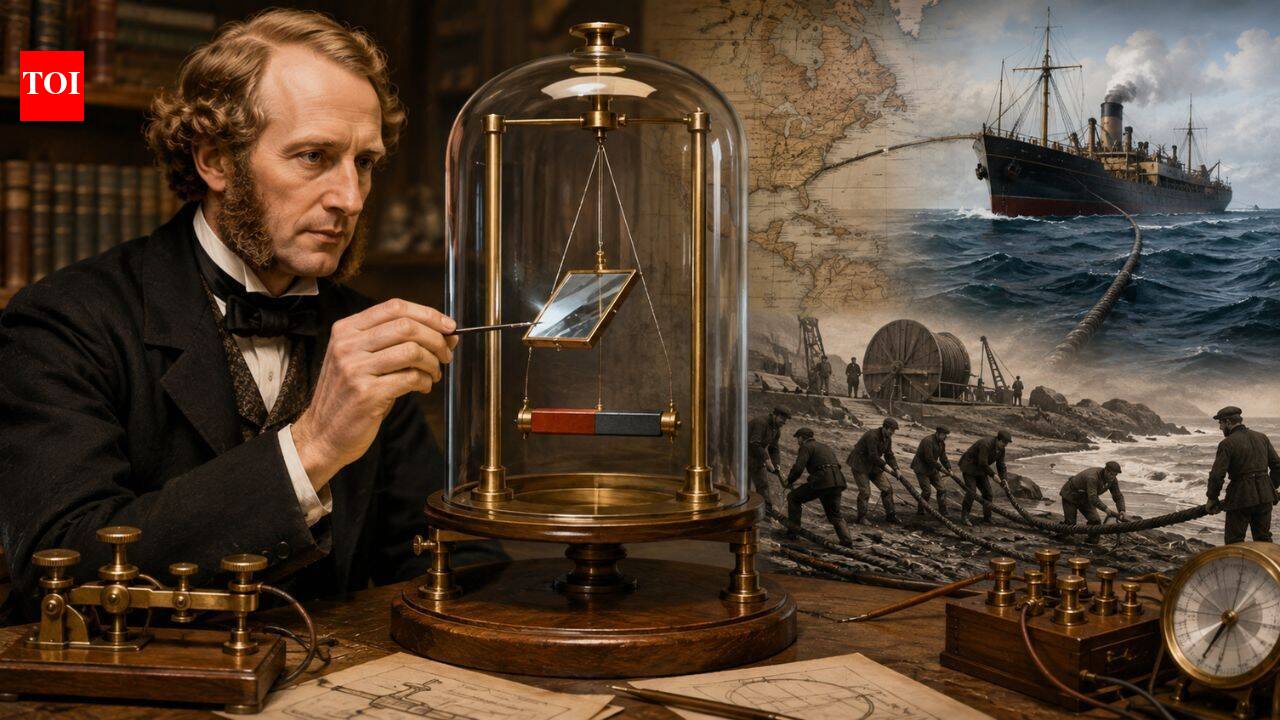
William Thomson, an Irish-born Scottish mathematician and physicist who later became Lord Kelvin, developed a mirror galvanometer that could detect electrical signals too weak for conventional instruments to register, addressing a central problem in transmitting messages through long submarine telegraph cables, including the first durable transatlantic connection established in 1866.
By the 1850s, telegraph systems were converting messages into electrical signals and sending them along land wires far faster than letters could travel by ship, train or horse. Extending that network across the Atlantic required laying a cable along more than 2,000 nautical miles of ocean floor between Ireland and Newfoundland, according to the source.
A long submarine cable behaved differently from a short land wire. Electrical signals became spread out and weakened over the distance, making conventional receiving equipment increasingly unreliable. Thomson's mathematical work had made him attentive to how electricity behaved in long conductors, and his involvement with the Atlantic Telegraph Company gave him a practical reason to apply that knowledge.
The mirror galvanometer worked by attaching a small bar magnet to the back of a light mirror, which was then suspended on fine silk threads inside a coil of wire. When a current passed through the coil, the magnet — and mirror — moved. A beam of light directed at the mirror produced a reflected spot that moved across a scale, turning a minute rotation at the instrument into a visibly larger displacement of light.
A Science Museum example of the device is dated to 1854, although Thomson's mirror galvanometer was patented in 1858, according to the History of the Atlantic Cable and Undersea Communications. Because the instrument required human interpretation, the Science Museum notes that two operators were needed: one to read and call out the reflected signal, and another to write it down.
The first serious transatlantic cable attempt in 1858 connected Newfoundland with Ireland but produced weak and unreliable signals, according to the History of the Atlantic Cable and Undersea Communications. Thomson's approach — building a highly sensitive receiver rather than increasing electrical power at the sending end — contrasted with the approach of Edward Orange Wildman Whitehouse, who favoured powerful electrical equipment.
By the time a durable transatlantic cable was established in 1866, the principle of using sensitivity rather than high electrical force had become an important part of submarine telegraphy. The source describes the achievement as requiring cable construction, insulation, electrical theory, navigation, shipbuilding, and laying techniques in addition to the receiving instrument.
Thomson was born in Belfast in 1824 to James Thomson, a professor of mathematics. He studied at Glasgow and Cambridge and became professor of natural philosophy at the University of Glasgow at a young age. He was raised to the peerage in 1892, taking the title Lord Kelvin from the River Kelvin, which ran close to the University of Glasgow.
- The source does not state the specific technical reasons why Whitehouse's approach of using powerful electrical equipment was considered inadequate or was set aside.
- The source does not detail the precise role Thomson played within the Atlantic Telegraph Company beyond describing his mathematical interest in the problem.
- The source does not specify what signals or tests were conducted with the 1854 Science Museum example of the mirror galvanometer prior to the 1858 patent.
- The source does not state how long it took operators to decode and transcribe a typical message using the mirror galvanometer.
- The source does not describe what insulation or cable construction methods ultimately made the 1866 connection durable compared with earlier attempts.
- The source does not indicate whether Whitehouse's equipment was used in any of the cable attempts or what the outcome of its use was.
Read the original at The Times of India