A strengthening tropical storm named Lala approached Hawaii's Big Island around August 15, carrying winds that both sources describe as capable of hurricane force, prompting Hawaii's governor to declare a state of emergency and airlines to cancel dozens of flights to and from the islands.
Hurricane Lala approaches Hawaii's Big Island, prompting flight cancellations and state of emergency
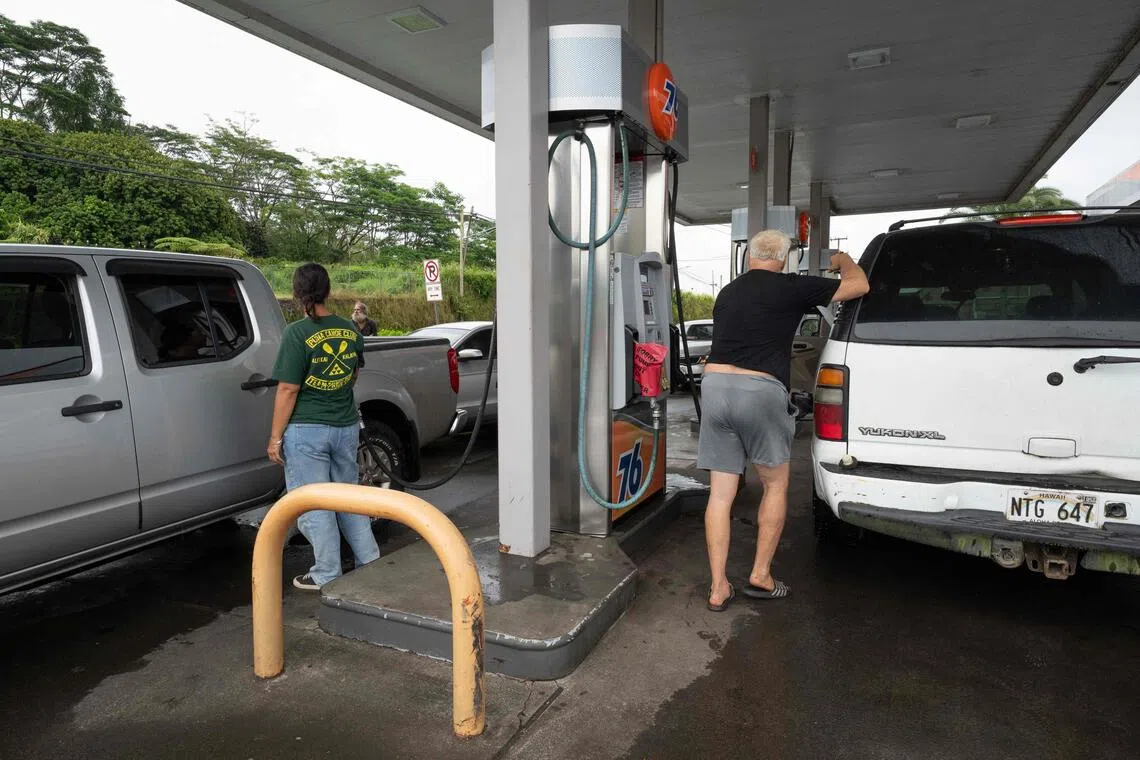
A strengthening tropical storm named Lala approached Hawaii's Big Island around August 15, carrying winds that both sources describe as capable of hurricane force, prompting Hawaii's governor to declare a state of emergency and airlines to cancel dozens of flights to and from the islands.
According to the New York Post, the storm was classified as a Category 1 hurricane with maximum sustained winds of 75 mph. The Straits Times reported wind gusts of up to 137 km/h. A hurricane warning was in effect for Hawaii County, which covers the Big Island, and a tropical storm warning applied to Maui, Molokai, and Kahoolawe, according to the Straits Times.
The National Oceanic and Atmospheric Administration (NOAA) forecast rainfall of up to 30 cm across Maui and the Big Island, with isolated pockets on the Big Island potentially receiving up to 63 cm, and storm surge of 30 to 90 cm, according to the Straits Times. The New York Post reported that higher elevations could see as much as 25 inches of rain, with some areas already receiving precipitation at a rate of 2 inches per hour.
Forecasters warned of life-threatening flooding and mudslides near the southern end of the Big Island, according to the New York Post. The Straits Times noted that rough conditions could persist into August 16.
According to the New York Post, a total of 59 neighbor island flights and 18 transpacific flights were canceled on Saturday, with five additional neighbor island flights and three transpacific flights also canceled for Sunday. Service at Hilo was suspended entirely, all Kona service after 2 p.m. was halted, and reduced schedules were operated at Kahului, Lihue, and Honolulu.
Governor Josh Green declared a state of emergency to ensure the state and its counties had sufficient resources to clear debris, secure infrastructure, and prepare, according to the Straits Times. Honolulu Mayor Rick Blangiardi said his administration had spent days preparing and urged residents to complete their preparations before conditions deteriorated.
Hawaii's emergency management agency advised residents to clear gutters and drains, move valuables off the ground, seal gaps in doors, and remove threatening tree limbs, according to the Straits Times. Residents were also told to stay away from beaches and coastal areas where rough surf and rip currents posed dangers.
If Lala were to make landfall on the Big Island, it would be the first hurricane to do so in 155 years, according to the New York Post. The Straits Times noted that the state was last struck by a major hurricane — Category 3 or above — in 1992, when Hurricane Iniki caused at least six deaths and billions of dollars in damage.
The Straits Times reported that Hawaii was previously threatened by Hurricane Fausto the prior month, before that storm weakened and passed north of the island chain. The outlet also noted that a powerful El Niño has formed in the central equatorial Pacific, with NOAA predicting a 69 percent chance of a historic event exceeding the strength of previous El Niño events dating back to 1950 when it peaks between October and December. El Niño tends to promote hurricane activity in the Pacific while suppressing it in the Atlantic, and human-caused climate change can amplify its impacts by increasing available energy and moisture, according to the Straits Times.
Where sources differ
- The New York Post characterized Lala as a Category 1 hurricane with 75 mph maximum sustained winds. The Straits Times described the storm as a 'strengthening tropical storm' with gusts up to 137 km/h (approximately 85 mph), without explicitly assigning a Saffir-Simpson category.
- The New York Post stated that higher elevations could receive up to 25 inches (approximately 63 cm) of rain. The Straits Times reported NOAA forecasts of up to 63 cm in certain pockets of the Big Island — these figures are broadly consistent but the framing differs, with the Post attributing the figure to 'higher elevations' and the Straits Times to 'certain pockets.'
- Neither source confirms whether Lala actually made landfall on the Big Island or provides post-landfall damage assessments.
- The specific airlines responsible for the transpacific cancellations are not fully identified across both sources.
- Neither source details the number of passengers affected or stranded by the cancellations.
- The precise track and timing of the storm's closest approach are not fully described.
- No response or comment from NOAA forecasters is directly quoted in either source.
- The basis for the '155 years' historical claim (the New York Post) is not identified or sourced to a specific agency or record.
- Neither source addresses what emergency shelters or evacuation orders, if any, were issued for Big Island residents.
- New York Post — original — by Daniel Farr
- The Straits Times — by The Straits Times
Read the original at New York Post