Hungary's National Assembly voted on Tuesday to confirm Andras Baka, a 73-year-old former chief of Hungary's Supreme Court and longtime critic of former Prime Minister Viktor Orban, as the country's next president. The vote produced 140 votes in favour and six against, with Orban's Fidesz party boycotting the proceedings. Baka replaces Tamas Sulyok, an Orban appointee who was removed from the role through a constitutional amendment passed by Magyar's TISZA party.
Hungary's parliament elects Andras Baka as president, replacing Orban-era appointee
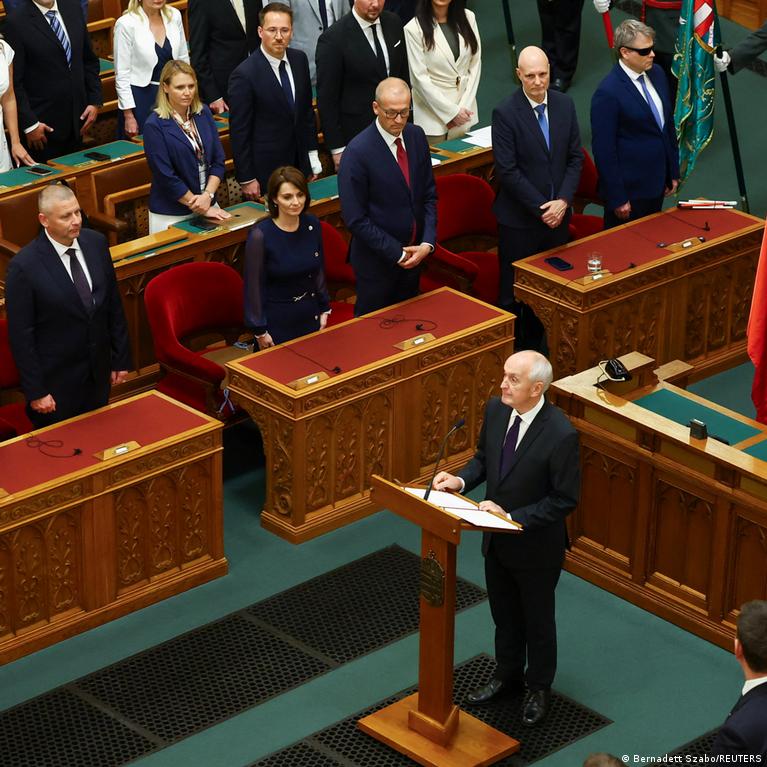
Hungary's National Assembly voted on Tuesday to confirm Andras Baka, a 73-year-old former chief of Hungary's Supreme Court and longtime critic of former Prime Minister Viktor Orban, as the country's next president. The vote produced 140 votes in favour and six against, with Orban's Fidesz party boycotting the proceedings. Baka replaces Tamas Sulyok, an Orban appointee who was removed from the role through a constitutional amendment passed by Magyar's TISZA party.
Baka spent nearly two decades as a judge at the European Court of Human Rights in Strasbourg before returning to Hungary in 2009 to lead its Supreme Court. According to Al Jazeera, he was removed from that post two years later — Deutsche Welle puts the removal in December 2011, noting it came three years before his term was due to expire — after he publicly criticised Orban's government reforms, which he said threatened judicial independence.
TISZA, which holds a constitutional majority of more than two-thirds of seats in parliament following its landslide victory in April's general elections, had nominated Baka on Saturday, according to Al Jazeera. During the nomination, TISZA lawmakers described his experience as 'a significant asset' as the party works to lay 'the foundations for Hungary's new constitutional order.' The vote proceeded largely along party lines; TISZA holds 141 seats and Fidesz holds 52, according to Deutsche Welle.
TISZA used the same two-thirds majority to amend the constitution and bring Sulyok's term to an early end, a move Fidesz and its nationalist KDNP allies called 'tyrannical' and 'illegitimate,' according to Deutsche Welle. Magyar has argued the step was necessary to pursue the 'system change' he promised voters. Some rights watchdogs also drew comparisons between Sulyok's removal and the methods used during the Orban era, Deutsche Welle reported.
Baka himself addressed those comparisons before Tuesday's vote, telling AFP last month, according to Deutsche Welle, that 'in a country governed by the rule of law, such extraordinary measures cannot be used, but Hungary became a captured state under Orban,' and that officials like Sulyok 'were appointed not to restrain the government's power, but to ensure the political survival of the former system even after an electoral defeat.'
Speaking to parliament after the vote, Baka struck a conciliatory tone, saying, 'There is one thing we certainly cannot do: we cannot build the new Hungary on revenge,' and vowing to uphold parliament's openness and impartiality, according to Deutsche Welle. Magyar said Baka's life served 'as an example of commitment to the democratic rule of law and constitutional principles.'
Earlier in the selection process, Magyar had floated chess champion Judit Polgar as a possible presidential candidate, but she declined, saying she did not feel she had 'the strength to take on the historic responsibility of uniting a divided nation,' according to Deutsche Welle.
TISZA has pursued other institutional changes alongside the presidential transition, including media reform, the establishment of an anticorruption task force, and an eight-year prime ministerial term limit that would effectively bar Orban from returning to office, according to Al Jazeera. According to Al Jazeera, Baka is set to assume office on August 19. The presidency is described by Al Jazeera as carrying mostly ceremonial powers, with limited authority to veto or refer legislation.
Where sources differ
- The two outlets differ on the method of the vote: Al Jazeera describes it as a 'secret ballot,' while Deutsche Welle does not characterise it as such and notes only that it went 'almost entirely along party lines.'
- On the timing of Baka's removal from the Supreme Court: Deutsche Welle states he was removed in December 2011, three years before his term was due to expire; Al Jazeera states he was removed 'two years later' after being elected head of the Supreme Court in 2009, implying removal around 2011 but without specifying it was three years early.
- No comment from Fidesz on the specific outcome of Tuesday's vote is included in either source beyond the pre-stated boycott.
- Neither source details the constitutional or legal process by which Baka's term as Supreme Court chief was ended in 2011 beyond stating he was 'removed.'
- The sources do not specify what formal powers or limitations Baka will face in the presidency beyond a general characterisation of the role as largely ceremonial.
- Neither source reports on any reaction from Sulyok himself to his removal or to Baka's confirmation.
- The identities of the six lawmakers who voted against Baka are not established by either source.
- Neither source addresses whether any legal challenges to the constitutional amendment removing Sulyok are pending.
- Deutsche Welle — original — by Mark Hallam
- Al Jazeera English
Read the original at Deutsche Welle