A major wildfire has burned through approximately 2,700 hectares — described by Deutsche Welle as Belgium's largest on record — in the High Fens nature reserve in eastern Liège province, prompting the evacuation of around 600 residents from municipalities near the German border and the activation of the European Union's civil protection mechanism to bring in international firefighting resources.
Wildfire burns roughly 2,700 hectares of Belgium's High Fens nature reserve, triggering EU civil protection mechanism
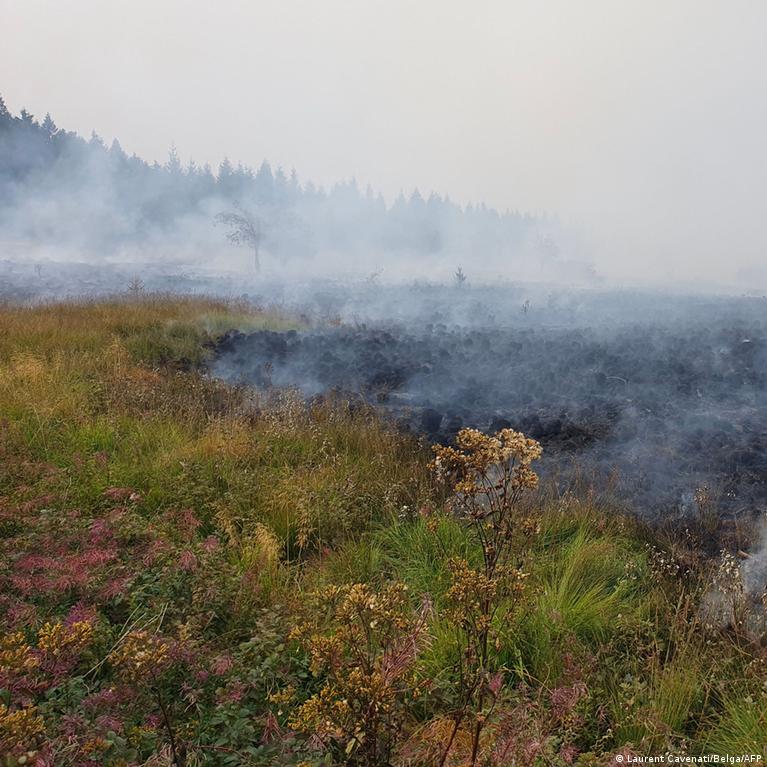
A major wildfire has burned through approximately 2,700 hectares — described by Deutsche Welle as Belgium's largest on record — in the High Fens nature reserve in eastern Liège province, prompting the evacuation of around 600 residents from municipalities near the German border and the activation of the European Union's civil protection mechanism to bring in international firefighting resources.
The fire, which broke out on Friday according to Deutsche Welle, spread rapidly across peatlands and pine forests. Shifting winds and heavy smoke drove authorities to order evacuations in parts of Waimes and Bütgenbach, with Deutsche Welle also naming Sourbrodt among the affected localities. Tourists and visitors were advised to leave the area, and a gymnasium in a neighbouring municipality was opened to shelter displaced residents.
Liège provincial governor Hervé Jamar said Sunday that more than 250 emergency responders had been deployed, including police, military personnel, civil protection workers, and over 100 Belgian and German firefighters, supported by helicopters from the Belgian federal police and the Netherlands, according to The Independent. Deutsche Welle additionally reported that firefighters from Luxembourg and local farmers assisting by wetting down surrounding land had joined the response.
Belgium activated the EU civil protection mechanism, bringing in aerial reinforcements. The Independent reported that Sweden dispatched two water-bombing aircraft and that two helicopters came from the Netherlands and one from the Czech Republic. Deutsche Welle described the same total of three helicopters and two water-bombing aircraft arriving from the Czech Republic, Sweden and the Netherlands, though the two sources attribute the aircraft differently by country.
EU Commissioner for Crisis Management Hadja Lahbib confirmed on social media that Belgium had requested international aid. According to The Independent, she stated: 'The High Fens are burning. Belgium is not facing it alone.' Deutsche Welle quoted her separately describing the blaze as a sign of the 'climate upheaval' affecting the continent, adding that 'never before has the wildfire season started so early in the year and reached such northern latitudes.'
René Dahmen, chief engineer at the Department of Nature and Forest, said Sunday that the fire was still expanding through terrain that ground crews found difficult to access. 'On the eastern flank, there's a line at least a kilometer long where the fire is slowly advancing toward a municipal forest,' he said, according to The Independent. 'The situation is extremely difficult. We need helicopter support,' he added.
Nicolas Yernaux, a spokesperson for the Public Service of Wallonia, was quoted by both sources. The Independent quoted him saying conditions were 'much deeper because we have very dry soil.' Deutsche Welle quoted him warning of a 'risk that the fire could reach homes' while noting that difficult terrain had forced firefighters to allow some inaccessible areas to burn.
According to The Independent, officials reported as of Sunday morning that no homes had been damaged. The blaze has surpassed a 2011 fire that burned nearly 14 square kilometres in the same reserve, which had previously been Belgium's largest recorded wildfire according to European Forest Fire Information System data cited by The Independent.
Weeks of hot and dry conditions preceded the fire. Belgium recorded temperatures approaching 37 degrees Celsius in several areas on the preceding Friday, a figure cited by both sources. Scientists, according to Deutsche Welle, say human-caused climate change is increasing the likelihood of conditions that allow wildfires to spread faster and burn longer.
In nearby Monschau, Germany, local authorities noted Sunday that the fire was roughly 1.5 kilometres from the border, according to The Independent, which said the flames were not currently expected to cross into German territory but that smoke would drift across. Deutsche Welle noted separately that the High Fens blaze was located just over the border from another major fire in western Germany that forced more than 2,000 residents from their homes. According to The Independent, those residents — from the village of Gey near Hürtgen — were able to return on Saturday evening after significant progress was made in controlling that separate blaze.
Where sources differ
- The two sources differ on which countries supplied which specific aircraft under the EU mechanism. The Independent states Sweden sent two water-bombing aircraft and the Netherlands and Czech Republic each sent a helicopter. Deutsche Welle lists the same total — three helicopters and two water-bombing aircraft — but attributes them collectively to the Czech Republic, Sweden and the Netherlands without the same country-by-aircraft breakdown.
- The Independent measures the burned area as roughly 30 square kilometres (12 square miles), while Deutsche Welle states approximately 2,700 hectares. These figures are broadly equivalent but are not identical, and the sources express them differently.
- Deutsche Welle describes the fire as Belgium's largest wildfire on record at the time of reporting. The Independent frames it as 'one of the country's worst blazes in recent history' and notes it surpassed a 2011 fire of nearly 14 square kilometres, without explicitly calling it the largest on record.
- The cause or origin of the fire has not been established in either source.
- No source specifies the precise breakdown of which country provided which aircraft type under the EU mechanism in a fully consistent way.
- The total estimated cost of damage to the nature reserve or economic impact has not been reported.
- The long-term ecological consequences for the High Fens peat bogs have not been assessed in either source.
- No timeline for when the fire might be brought under full control has been provided.
- Neither source reports a response or comment from Belgian federal government leadership beyond the Interior Minister's brief quoted reaction.
- The position of local Waimes and Bütgenbach municipal governments beyond the general evacuation measures is not described.
- The Independent — original — by Sylvie Corbet
- Deutsche Welle — by Timothy Jones
Read the original at The Independent