US President Donald Trump announced on Friday that the United States has secured majority control of more than 65 billion barrels of Venezuela's proven oil reserves through a partnership with private business, in what he described as 'the biggest oil deal in world history.' Venezuelan acting President Delcy Rodríguez addressed the nation on Saturday, defending the 25-year agreement as historic and economically transformative while insisting Venezuela retains ownership and sovereignty over its natural resources.
US and Venezuela announce oil deal giving Washington majority access to 65 billion barrels of reserves
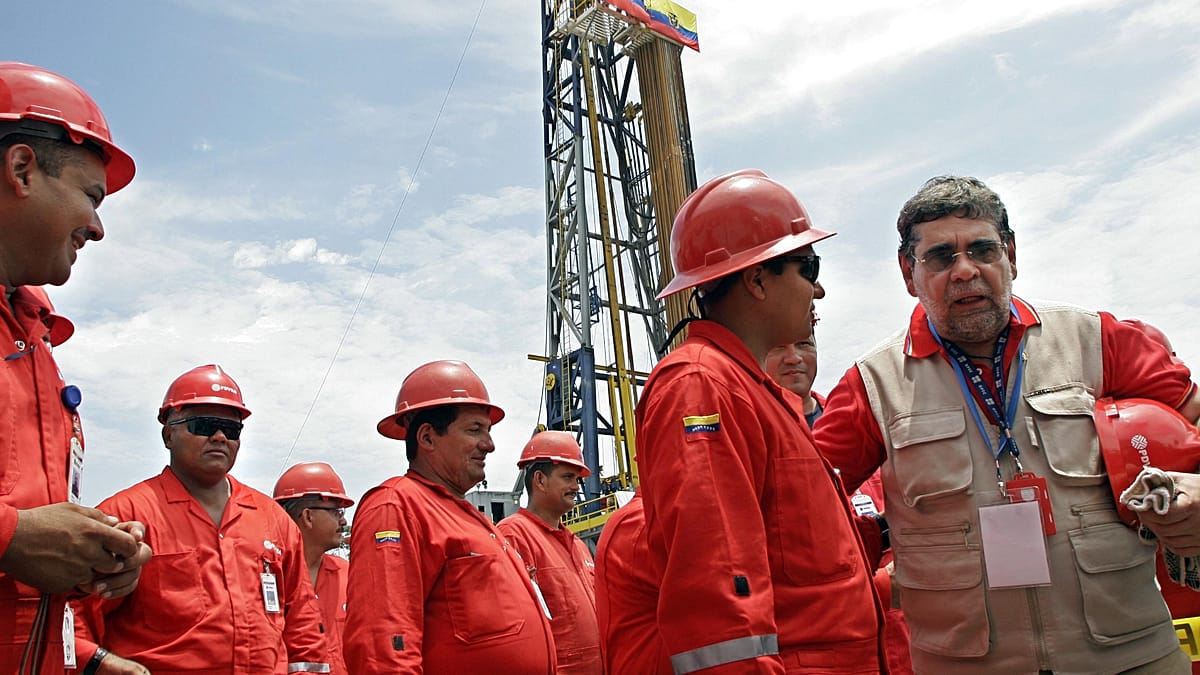
US President Donald Trump announced on Friday that the United States has secured majority control of more than 65 billion barrels of Venezuela's proven oil reserves through a partnership with private business, in what he described as 'the biggest oil deal in world history.' Venezuelan acting President Delcy Rodríguez addressed the nation on Saturday, defending the 25-year agreement as historic and economically transformative while insisting Venezuela retains ownership and sovereignty over its natural resources.
Trump announced the deal via social media on Friday, stating it was negotiated by Secretary of State Marco Rubio, Defence Secretary Pete Hegseth, and Rodríguez. Beyond that post, the White House provided little additional detail. In a separate post on X, Rubio called the agreement a 'huge win for both the American and Venezuelan people,' saying it demonstrated how Trump's foreign policy was 'securing stable reserves and low-cost oil in our Hemisphere and lowering gas prices here at home.'
In her televised national address on Saturday, Rodríguez described the accord as a '25-year bilateral project' that envisages the development of 17 strategic oilfields with a production target of more than 1.5 million barrels per day — a figure she said related solely to the bilateral agreement. She added that the broader plan also includes the development of eight greenfield oil blocks as part of a wider expansion.
Rodríguez said the agreement could generate approximately $209 billion in revenue for the Venezuelan state, based on a benchmark oil price of $65 per barrel, though she acknowledged crude prices could fluctuate. She said roughly $19 from each barrel produced and sold under the arrangement would flow directly to Venezuela. The deal could also attract more than $100 billion in investment into Venezuela's oil industry, according to Rodríguez.
According to the US structure described by multiple sources citing an anonymous US official not authorised to speak publicly, the US government and an unnamed private operator in Venezuela formed a new company granted rights to untapped oil fields for 100 years. The US will receive 55 per cent of the new company's effective output through an ownership stake and the right to buy oil at cost. Oil purchased by the US would go towards its strategic oil reserves and the military. The company would become the second-largest corporate holder of proven oil reserves after Saudi Aramco, according to the official.
According to the Times of India, citing the Wall Street Journal and people involved in negotiations, the US government plans to take a 35 per cent passive stake in North American Blue Energy Partners, owned by Venezuelan businessman Alejandro Betancourt.
Venezuela has the world's largest proven oil reserves but currently produces approximately 1.2 to 1.25 million barrels per day, well below its historical peak. Euronews reported that oil production rose 29.8 per cent between January and July, reaching 1.2 million barrels a day, though this remains far below the three million barrels a day recorded 25 years ago. New York Post noted the country previously produced more than 2.5 million barrels a day above current levels before years of underinvestment, mismanagement and sanctions.
Experts cautioned that any significant boost in production would not occur quickly. Amy Myers Jaffe, director of the Energy, Climate Justice and Sustainability Lab at New York University, said the deal could be 'helpful in the long run, but it's not going to do anything to change the price of gasoline at the retail station for Labor Day weekend.' Kevin Book, managing director at ClearView Energy Partners, said it would take 'many years' to deploy sufficient capital to produce 'the kind of incremental results that history suggests possible.' The average US gasoline price stood at approximately $4.08 a gallon on Saturday, according to AAA, compared with $3.20 at the same time last year.
Oswaldo Felizzola, a professor at the Institute of Advanced Studies in Administration in Venezuela, told AFP, according to Euronews, that without the US acting as a guarantor for investments, 'these fields would not be developed over the next 10 or 15 years,' adding that Venezuela's state-owned firm Petróleos de Venezuela lacked the financial resources to do so.
Rodríguez became acting president after the US military captured her predecessor, Nicolás Maduro, in a raid in January and brought him to New York to face federal drug trafficking charges, according to ABC News Australia. She had previously served as Maduro's vice-president.
According to New York Post, Venezuelan officials are preparing to sign agreements granting new oil exploration and production rights to several companies, including US firms, next week. Two sources close to the negotiations said Chevron was among the companies expected to finalise talks. Both Chevron and ExxonMobil declined to comment, according to ABC News Australia. Earlier on Saturday, dozens of pro-government groups gathered in downtown Caracas to protest against the US presence in Venezuela, according to New York Post.
David Oxley, chief climate and commodities economist at Capital Economics, said the deal could on the face of it double US oil reserves and reduce dependence on crude from Canada and Mexico, but cautioned there were logistical hurdles and said the value of Venezuela's reserves may have been exaggerated, according to ABC News Australia.
Where sources differ
- On current Venezuelan oil production: Euronews reports 1.2 million barrels per day as of January–July; New York Post reports approximately 1.25 million barrels per day; the figures are close but not identical.
- On Venezuela's historical production peak: Euronews states three million barrels per day recorded 25 years ago; New York Post and Times of India state the country previously produced more than 2.5 million barrels per day above current levels, implying a higher total, without specifying a timeframe in the same terms.
- On the nature of the US's 55 per cent stake: ABC News Australia and Times of India report it comes through an ownership stake and the right to buy oil at cost, but note it remains unclear what portion derives from each mechanism; no source fully resolves this breakdown.
- The identity of the unnamed private operator that partnered with the US government in the new company has not been publicly confirmed in any source.
- The precise breakdown of the US's 55 per cent effective output share — how much derives from an ownership stake versus the right to buy oil at cost — has not been clarified by either government.
- Who will fund the infrastructure investment required to repair Venezuela's dilapidated oil sector, and at what total cost, has not been stated by either side.
- The full legal text and terms of the agreement have not been made public; the White House provided little beyond Trump's social media post.
- How the deal will interact with existing US sanctions on Venezuela's oil sector has not been explained in the sources.
- The constitutional and legal basis under Venezuelan law for Rodríguez, as acting president, to enter into such a long-term agreement has not been addressed by the Venezuelan government in any source.
- Chevron's and ExxonMobil's formal positions on the deal and their potential participation have not been stated; both declined to comment.
- The reaction of the broader Venezuelan population, opposition political figures beyond Hausmann, and international governments has not been captured in the sources.
- The identity of Venezuelan businessman Alejandro Betancourt and the structure of North American Blue Energy Partners, cited by Times of India via the Wall Street Journal, are not further elaborated in any source.
- No source establishes whether the agreement has yet been formally signed.
- Euronews — original — by Rafael Salido
- New York Post — by Reuters
- ABC News Australia
- The Times of India — by SHIVANGHI PAYAL