The U.S. Secret Service says the use of card skimming devices — which capture account details and personal identification numbers from bank and government benefits cards — is increasing, costing financial institutions and consumers more than $1 billion each year, according to agency estimates. A CBS News ride-along with Secret Service agents in Los Angeles, during which 328 businesses and 1,749 devices were inspected, resulted in the seizure of 16 skimmers and an estimated $16.6 million in prevented fraud losses.
Secret Service Reports Rise in Card Skimming Devices Targeting Bank and Government Benefit Cards
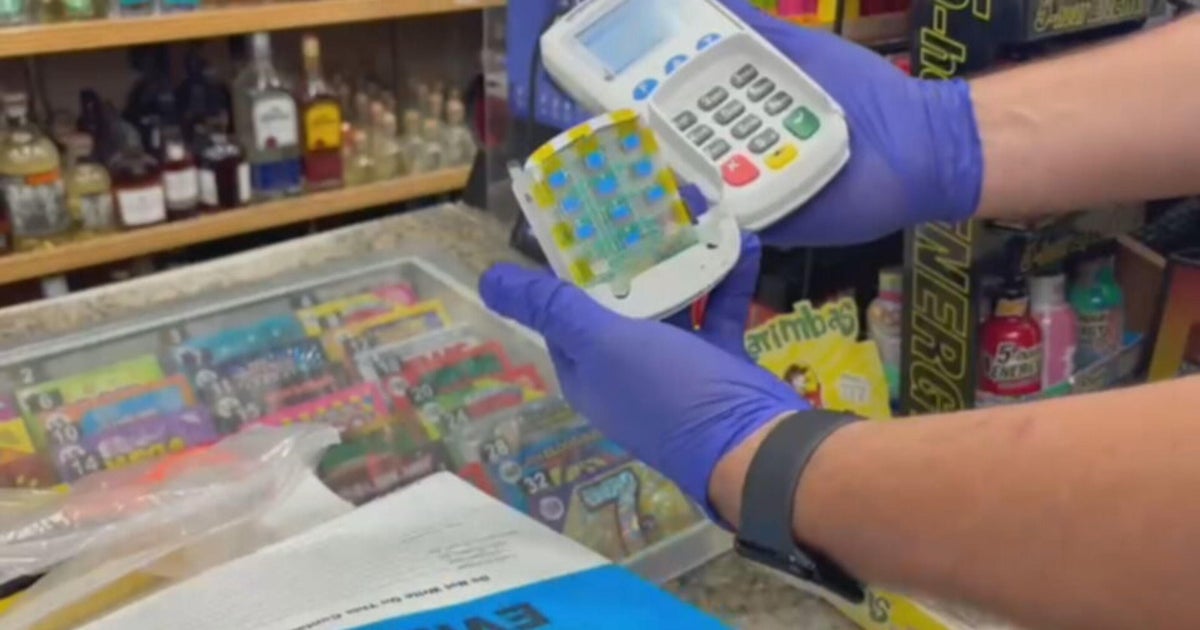
The U.S. Secret Service says the use of card skimming devices — which capture account details and personal identification numbers from bank and government benefits cards — is increasing, costing financial institutions and consumers more than $1 billion each year, according to agency estimates. A CBS News ride-along with Secret Service agents in Los Angeles, during which 328 businesses and 1,749 devices were inspected, resulted in the seizure of 16 skimmers and an estimated $16.6 million in prevented fraud losses.
Skimming devices can be installed in seconds on debit and credit card readers, ATMs, or other card terminals. Once in place, the devices collect data each time a card is swiped. In many cases, a wireless transmitter hidden inside the skimmer sends the captured data to the perpetrators remotely.
Secret Service analyst Vince Porter told CBS News that officials believe a single skimmer can generate up to $1 million in stolen funds. The devices are described as difficult to recognize and, in some cases, difficult to remove — law enforcement has had to pry skimmers off terminals, leaving residue behind. There is no way to determine how long a device has been in operation, Porter said.
In 2025 alone, the Secret Service removed more than 400 illegal skimming devices, which the agency characterized as a fraction of all devices in circulation. A CBS News investigation identified 32 active federal probes spanning 15 states. The Secret Service and its law enforcement partners say skimming activity has increased over the past two years.
Special Agent Michael Peck, who leads the Secret Service's criminal investigative division, said organized criminal groups originating from outside the United States are responsible for the activity. These groups enter the country from Eastern Europe, Asia, and Central and South America, with many crossing the U.S.-Mexico border. Peck told CBS News that one subject was apprehended after traveling from Canada by Jet Ski.
Stores that accept Electronic Benefit Transfer cards — which hold government assistance funds including food stamps and Section 8 housing payments — are frequently targeted, according to Porter. He noted that many government assistance cards must be swiped rather than tapped, making them more vulnerable because they lack the added security of tap-and-pay or chip technology. When stores advertise that they accept such funds, they can become targets, Porter said, describing it as 'a one-stop crime.'
Victims who have their government benefits stolen have limited options for recovery, according to the Secret Service, because of the number of agencies involved in distributing the funds. Mary Bowen, described as a mother of six who relies on government assistance, told CBS News that her benefits were stolen the previous week, leaving her unable to pay rent or buy groceries. 'I've been getting food from my friends because they took everything,' she said.
Similar enforcement operations have been conducted in dozens of U.S. cities. Skimming activity is most concentrated in major cities such as Los Angeles, but the Secret Service says smaller communities are also at risk. Peck advised consumers to use tap-and-pay methods whenever possible, describing it as 'the best way to protect yourself as a consumer,' while noting that government benefit cardholders typically do not have that option.
- The source does not identify or quote any of the criminal suspects or organizations accused of operating skimming networks.
- The source does not describe what legal charges, if any, have been filed in connection with the 32 active federal probes.
- The source does not detail what recourse, if any, government agencies are offering to benefit card holders whose funds have been stolen.
- The source does not indicate the specific breakdown of losses between financial institutions and individual consumers within the $1 billion annual estimate.
- The source does not explain how the $16.6 million in 'prevented fraud loss' figure was calculated.