A drone carrying explosives landed at Leipzig/Halle airport and reportedly remained undetected for several hours, prompting German Interior Minister Alexander Dobrindt to describe the incident as a 'hybrid attack scenario' he suspects originated from 'foreign powers,' with suspicion directed at Russia. The Federal Prosecutor's Office has taken over the investigation.
Explosive-laden drone at Leipzig/Halle airport exposes gaps in German drone defense
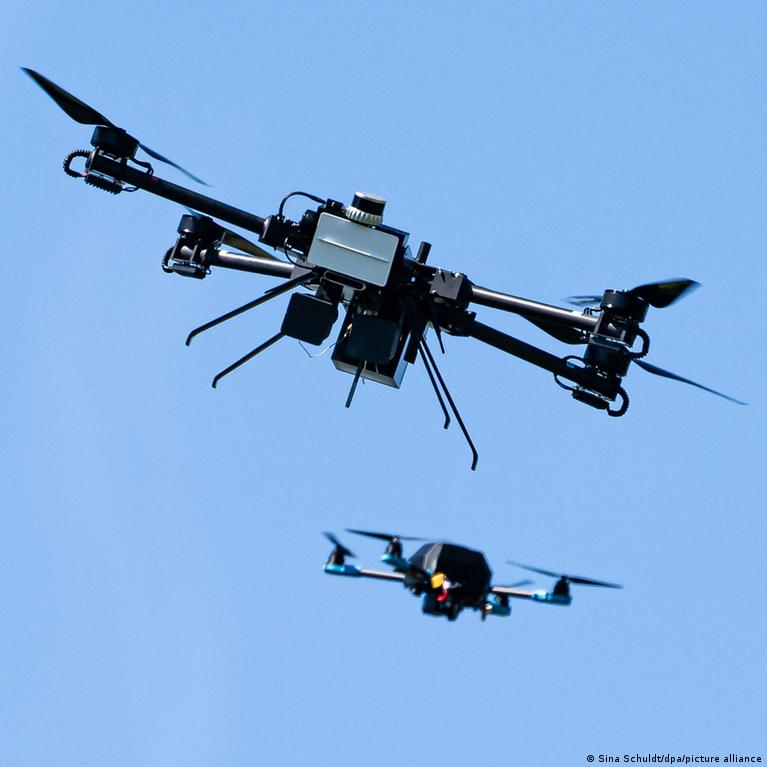
A drone carrying explosives landed at Leipzig/Halle airport and reportedly remained undetected for several hours, prompting German Interior Minister Alexander Dobrindt to describe the incident as a 'hybrid attack scenario' he suspects originated from 'foreign powers,' with suspicion directed at Russia. The Federal Prosecutor's Office has taken over the investigation.
The drone was said to have been found near a Ukrainian Antonov cargo plane at the airport. Security experts described the incident as representing a new level of threat, given that an explosive-laden drone was able to reach airport tarmac.
Drone sightings over German airports, ports, industrial sites, and military properties have been rising. Germany's Federal Criminal Police Office (BKA) recorded more than 1,000 suspicious drone flights in 2025. Last October, drones disrupted air traffic at Munich airport for several hours, stranding numerous passengers.
Germany launched the Joint Counter Drone Center (GDAZ) in Berlin in December, where information from federal police, state police, intelligence services, and the armed forces is collated around the clock. However, the Leipzig incident occurred despite that center being operational.
Germany's divided jurisdictional structure complicates coordinated responses: suspicious drones are initially handled by state police — one authority for each of Germany's 16 states — and federal police may only intervene once a drone moves over a large airport or railway facility. Germany amended its air security law in March, for the first time permitting the Bundeswehr to shoot down drones outside their own premises to prevent 'a particularly serious disaster.'
The federal police established a new special drone defense unit in December. Following the Leipzig incident, Dobrindt announced an expansion from the originally planned 130 staff positions across four locations to 300 personnel across eight locations. An Interior Ministry spokesperson said eight large airports — Frankfurt (Main), Munich, Berlin, Düsseldorf, Hamburg, Cologne/Bonn, Stuttgart, and Leipzig/Halle — are prioritized for mobile drone defense technology, with the plan to equip all of them by the end of the year.
- The source does not state the exact date of the Leipzig/Halle airport incident.
- The source does not establish who or which entity is specifically suspected of directing the drone, beyond general suspicion toward Russia.
- The source does not state how the drone was ultimately discovered or by whom.
- The source does not specify what type or quantity of explosives the drone carried.
- The source does not state whether any arrests or detentions have been made in connection with the incident.
- The source does not indicate whether the Ukrainian Antonov cargo plane or its crew were targeted or affected.
Read the original at Deutsche Welle