Iran's military command, paramilitary leaders and senior diplomats publicly rejected on Thursday US President Donald Trump's claim of 'total control' over the Strait of Hormuz, calling his statements 'lies and fabrications,' as independent shipping data showed vessel transits through the waterway remained far below pre-war levels, with the standoff rooted in the broader US-Iran conflict that began on 28 February 2026.
Iran and US exchange conflicting claims over control of Strait of Hormuz as shipping traffic remains severely depressed
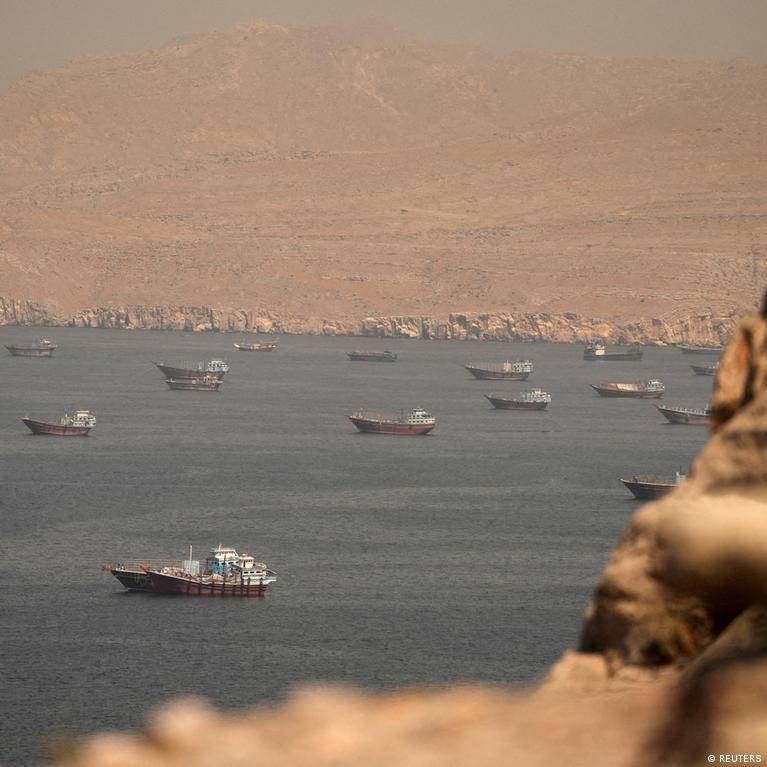
Iran's military command, paramilitary leaders and senior diplomats publicly rejected on Thursday US President Donald Trump's claim of 'total control' over the Strait of Hormuz, calling his statements 'lies and fabrications,' as independent shipping data showed vessel transits through the waterway remained far below pre-war levels, with the standoff rooted in the broader US-Iran conflict that began on 28 February 2026.
In a Wednesday post on his Truth Social platform, Trump wrote that the United States 'has total control over the Strait of Hormuz,' adding 'I THINK WE WILL KEEP IT!' He also described the US naval presence as a 'WALL OF STEEL' and said 'there is nothing Iran can do about it.' Separately, Trump told reporters at Joint Base Andrews that 'We totally control the Strait of Hormuz. We have control over it; nobody else, only us,' and told reporters at the White House that 'We've mine-swept the entire strait,' according to Deutsche Welle.
Iran's central military command spokesperson Ebrahim Zolfaghari responded on Thursday in a video carried by state television, saying: 'The false claims of the United States that ships are passing through the Strait of Hormuz normally...are nothing more than lies and fabrications.' He added that 'no commercial ship or tanker without the permission and supervision of the powerful Iranian armed forces has had and will have the possibility of safe passage through this strait.'
Hossein Taeb, head of Iran's paramilitary Basij forces under the Revolutionary Guards, also said on Thursday that 'the Strait of Hormuz is under the management and control of the Islamic Republic,' adding that Iran was 'continuing on its path in complete security,' according to state television and Iran's semi-official Fars news agency. Taeb further said the United States had sought to undermine what he described as the Islamic Republic's regional standing but had 'once more been defeated despite claiming Iran had neither an air force nor a navy,' according to multiple sources.
Iran's Foreign Minister Abbas Araghchi posted on X that 'The US has long miscalculated due to intelligence failures. Case in point: The war on Iran. Now, an even bigger miscalculation on the Strait of Hormuz.' Iran's Persian Gulf Strait Authority stated on X that 'the successive claims and tweets by American officials about lifting the blockade of the Strait of Hormuz do not change reality' and that the strait 'remains blocked' until Iran's conditions are accepted, according to The Independent.
Iranian parliamentarian Behnam Saeedi, a member of the national security commission, said on state television that ships belonging to Israel 'will not have the right to pass through the Strait of Hormuz under any circumstances, whether in war or peacetime,' and that US military ships would also be barred.
Mohsen Rezaei, the newly appointed head of Iran's Supreme National Security Council, told China's ambassador to Tehran that 'As long as America does not change its behaviour and does not accept Iran's conditions, the Strait of Hormuz will not be opened,' according to the semi-official Tasnim news agency. Writing on X, Rezaei listed Iran's conditions as: an end to the US naval blockade on Iranian ports, a region-wide ceasefire including in Gaza and Lebanon, the release of Iran's frozen assets, and an end to the war.
Iran's six formal conditions for reopening the strait, announced by the Supreme National Security Council, were reported by Al Jazeera as: an end to US threats and insults against Iran; a permanent end to attacks on Iran and its allies in Lebanon, Palestine, Yemen and Iraq; the lifting of the US naval blockade and withdrawal of US naval and air forces; compensation for damages from two 'imposed wars'; the lifting of sanctions; and the unconditional release of frozen Iranian assets.
Iran has maintained control of the strait since the outbreak of the conflict on 28 February, requiring vessels to obtain permission and pay transit fees, according to multiple sources. Tehran says even a potential new route arrangement being negotiated with Oman would not on its own reopen the waterway unless the US meets its demands.
According to The Independent, citing trade intelligence firm Kpler, shipping traffic through the strait was near a three-month low, with just 13 vessels transiting on Tuesday, approximately 90 percent below the pre-war daily average of around 130 ships. Al Jazeera, also citing Kpler via Reuters, reported that eight vessels transited the strait on Tuesday — the lowest daily tally since 5 August — below the 10-day average of about 12. The strait carried around one-fifth of global crude exports before the conflict began, according to Deutsche Welle and Al Jazeera.
Iran and Oman have been engaged in talks on a new shipping route through the strait. Qatar's Foreign Ministry spokesman Majed al-Ansari said talks had reached 'an advanced stage,' and earlier this month Iran's Foreign Ministry spokesman Esmaeil Baghaei indicated the two sides were preparing a joint statement covering technical, legal, security and environmental points, according to Euronews. However, according to Al Jazeera, negotiators have agreed on coordinates for a route but disagree over whether Iran can control incoming traffic and impose transit fees — both of which Washington rejects. Iran maintains that any Oman agreement would have no bearing on the actual reopening of the strait.
The conflict has prompted Gulf energy exporters to seek alternative shipping routes. According to Deutsche Welle, citing IMF PortWatch data, Saudi Arabia redirected crude through its East-West Pipeline to the Red Sea port of Yanbu: during April and May, Saudi cargo shipments from its Gulf coast fell from 47.5 million tons in the prior year to 6.3 million tons, while Red Sea exports rose from 29.6 million to 54.8 million tons, replacing roughly 61 percent of the lost volume. The UAE has had less success; its Persian Gulf coast traffic fell to 12 million tons from 68.5 million tons in the same period of 2025, and traffic through its alternative ports also declined, from 13.7 million to 6.3 million tons. Economist Hassan Mansour told Deutsche Welle that longer-term alternatives such as new Iraq-Oman or Iraq-Jordan pipelines, or Cape of Good Hope sea routes, would take five to seven years and cost billions of dollars.
On Monday, Trump said the US would demand compensation from Iran for deaths and injuries linked to Iranian actions over several decades. Iran had previously issued its own reparations demands. Al Jazeera reported that Trump's vice president, JD Vance, had said on the preceding Saturday that he was confident a deal could be reached and that Iran had told the US it had 'no plans' to impose tolls on the strait — a claim that appeared to conflict with Iran's stated position. There was no immediate White House comment on Iran's formal six-point conditions list, according to NPR.
A senior Iranian source told Reuters, as reported by The Independent, that there had been 'absolutely no progress' on efforts to revive the interim ceasefire agreement reached in June, and dismissed a report from Turkey's Anadolu news agency that quoted Pakistani government sources as saying the 60-day ceasefire period had been extended. 'There is no talk of an extension because, from Iran's perspective, there is no period that began and therefore nothing to extend. The United States violated the interim agreement 48 hours after it was reached,' the source said.
On Tuesday, US Central Command reported that a US Navy MH-60 helicopter fired two Hellfire missiles at a Panama-flagged cargo vessel, the M/V Vela Nova, in the Gulf of Oman after it allegedly ignored repeated warnings and attempted to violate the US naval blockade of Iranian ports. The strike disabled the ship's steering gear; no crew casualties were reported by CENTCOM, according to Al Jazeera.
Six people were killed in a Houthi attack on a cargo vessel in the Bab al-Mandeb strait, according to Yemeni authorities cited by Al Jazeera. Four crew members of the Egyptian-owned Tihamah were killed, along with two Yemeni rescuers. Al Jazeera described the incident as the first deaths from Houthi strikes on shipping since the Iran war began. Houthi-affiliated media later reported the ship carried Saudi military equipment; there was no immediate Saudi response.
According to Al Jazeera, casualty figures from the broader conflict include at least 3,527 people killed and more than 27,000 wounded in Iran, and at least 18 Americans killed. In Lebanon, more than 4,300 people have been killed and more than 12,000 injured since Israeli military escalation began on 2 March, according to Lebanon's Health Ministry. In Israel, at least 60 people have been killed in Iranian and Hezbollah attacks.
According to Al Jazeera's analysis from Doha, Saudi Arabia signed the Mecca Joint Defence Agreement with Turkey and Pakistan on Friday, under which an armed attack on one signatory is considered an attack on all. A regional official familiar with the security discussions told Al Jazeera that Iran would likely test the pact through a proxy. The agreement does not spell out specific mutual obligations following an attack.
According to The Independent, citing a CNN analysis, approval of Trump's handling of Iran among voters highly motivated to vote in the midterms stood at 29 percent in a July poll, compared with 53 percent who expressed confidence in Trump's ability to handle Iran in a July 2024 poll.
Where sources differ
- Shipping transit figures: The Independent, citing Kpler, reported 13 vessels transited the strait on Tuesday, approximately 90 percent below the pre-war average of 130; Al Jazeera, also citing Kpler via Reuters, reported eight vessels on the same day — described as the lowest since 5 August and below the 10-day average of about 12. The sources differ on the daily vessel count.
- Whether negotiations are ongoing: The US has said it is involved directly in talks; Iran has stated it is speaking only with Oman and not directly with the US, with messages exchanged through intermediaries, according to multiple Al Jazeera reports.
- Whether a ceasefire extension is in effect: A Turkish state news agency report cited Pakistani government sources saying a 60-day period had been extended; an unnamed senior Iranian source told Reuters there was no such extension and no active period to extend.
- Framing of US control: Trump and US officials have asserted the US has 'total control' over the strait and has mine-swept it; multiple Iranian officials, Iran's Persian Gulf Strait Authority, and shipping data cited by The Independent and Al Jazeera indicate the strait remains substantially under Iranian management and largely closed to commercial traffic.
- No official US government response to Iran's formal six-point conditions list had been issued at the time the sources were published, according to NPR and Al Jazeera.
- The sources do not establish the current precise status of Iran-Oman negotiations or when or whether a joint statement will be finalised.
- The sources do not confirm whether any commercial ships have paid Iranian transit fees or obtained permission to transit the strait under the current regime, or the scale of such payments.
- The sources do not establish the specific amount of compensation Iran is demanding from the US or others for the oil spill at Qeshm Island, or from whom.
- The sources do not establish whether any formal diplomatic channel between the US and Iran directly (as opposed to through intermediaries) exists or is functioning.
- The sources do not establish the current status of Iran's nuclear programme or whether nuclear talks are formally suspended.
- The sources do not establish the Houthis' official position on the Tihamah attack in the Bab al-Mandeb; Al Jazeera noted the Houthis had not directly commented on the vessel at the time of reporting.
- The sources do not establish Saudi Arabia's official response to the Houthi report that the Tihamah was carrying Saudi military equipment.
- The sources do not establish the legal or operational obligations of Turkey and Pakistan under the Mecca Joint Defence Agreement, or how it would be triggered in practice.
- The sources do not provide independent verification of either side's claims about actual ship transit volumes or the degree of naval presence in the strait.
- The extent and verified casualty figures from the broader conflict are drawn largely from Iranian government, Yemeni government and Lebanese Health Ministry sources; independent verification is not established by the sources.
- France 24 — original — by FRANCE 24
- Africanews — by @africanews
- Euronews — by Gavin Blackburn
- CBS News — by Frank Andrews
- The Jerusalem Post — by REUTERS
- The Straits Times — by The Straits Times
- The Independent — by Suha Kidwai
- Deutsche Welle — by Amir Soltanzadeh
- Deutsche Welle — by Amir Soltanzadeh
- Al Jazeera English — by Usaid Siddiqui
- Al Jazeera English — by Al Jazeera Staff
- Al Jazeera English — by Usaid Siddiqui
- Al Jazeera English
- NPR News
- Al Jazeera English — by Mark Pfeifle
Read the original at France 24