Eritrea's strategic position along more than 1,000 kilometers of Red Sea coastline, including the ports of Assab and Massawa near the Bab-al-Mandab Strait, has drawn growing diplomatic attention from regional and global powers, according to analysts interviewed by DW. In July, diplomatic consultations in Cairo brought together Egypt, Somalia, Eritrea, and a senior US envoy to discuss security challenges in the Horn of Africa and Red Sea trade.
Eritrea's Red Sea coastline draws competing geopolitical interests amid regional tensions
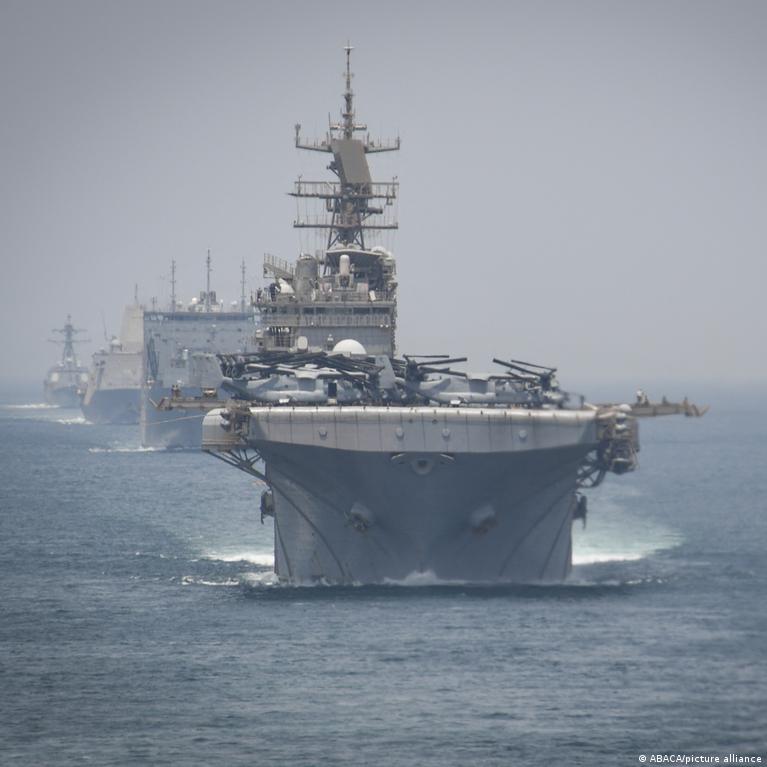
Eritrea's strategic position along more than 1,000 kilometers of Red Sea coastline, including the ports of Assab and Massawa near the Bab-al-Mandab Strait, has drawn growing diplomatic attention from regional and global powers, according to analysts interviewed by DW. In July, diplomatic consultations in Cairo brought together Egypt, Somalia, Eritrea, and a senior US envoy to discuss security challenges in the Horn of Africa and Red Sea trade.
Abdurahman Sayed, director of the Horn of Africa Centre for Regional Integration (CRI) in London, said Eritrea's location is made particularly significant by the situation directly across the Red Sea. 'Yemen lies on the other side of the Red Sea, which makes Eritrea's location particularly interesting, as Yemen is in a state of crisis and maritime security in the region is at risk,' he told DW. 'The only safe route in this area runs through Eritrea, where there are currently no security concerns.'
Iran-backed Houthi forces have been attacking merchant vessels in the Red Sea from the Yemeni coastline. A UN Refugee Agency report published last month described Yemen as experiencing one of the world's worst humanitarian crises, driven by ongoing violence, economic collapse, droughts, and floods.
The broader conflict involving Iran has reinforced the importance of maritime chokepoints such as the Strait of Hormuz and the Bab-al-Mandab, according to Sayed. He noted that Gulf states — Saudi Arabia, Kuwait, Bahrain, Qatar, and the United Arab Emirates — regard the Red Sea as a crucial trade route, and that Saudi pipelines running to the port of Yanbu-Al-Bahr on the Red Sea offer a potential alternative should Hormuz be blocked, though he said that route could be vulnerable to security disruption.
Eritrea gained independence in 1993 under President Isaias Afwerki, who has governed the one-party state since then with no elections held in its 32-year history. Sayed noted that this concentration of power creates a potential vulnerability: 'The country is ruled by a single man, and there are no constitutional institutions. That makes the state very vulnerable should this strongman be removed from power.' Afwerki is 80 years old and no clear successor has been identified within his inner circle, according to Sayed.
Landlocked Ethiopia lost direct sea access when Eritrea became independent in 1993 and has since relied on neighboring countries, primarily Djibouti, for its maritime trade. Ethiopian Prime Minister Abiy Ahmed has for years demanded sovereign access to the sea. Earlier in 2026, relations between Ethiopia and Eritrea had already threatened to escalate amid a dispute over Ethiopia's maritime trade access, according to the source.
In May 2026, Eritrea and Egypt signed an agreement to establish direct freight connections between their respective Red Sea ports. Michael Woldemariam, a researcher at the School of Public Policy at the University of Maryland and the Atlantic Council, told DW that Eritrea's recent diplomatic activity — including outreach to Egypt, Somalia, the United Arab Emirates' armed forces, Saudi Arabia, Ethiopian opposition groups, and the United States — should be understood as an effort to build counterweights to Ethiopia.
At least 700,000 people have left Eritrea since its founding, representing approximately one-fifth of its total population, according to the source. The country's population growth rate is under 2%. Magnus Treiber, a migration researcher at the Institute of Ethnology at the University of Munich who specializes in the Horn of Africa, told DW that the causes of flight from Eritrea have included imperial and military repression, human rights violations, military service, war, and lack of economic prospects stretching back to 1967. Treiber said that since the European Union now offers 'virtually no opportunities to seek asylum,' Eritreans are fleeing to destinations across the world.
- The source does not state the specific terms or scope of the May 2026 Eritrea-Egypt freight agreement.
- The source does not identify the US envoy who attended the July Cairo consultations or their title.
- The source does not state the precise date of the July Cairo diplomatic consultations.
- The source does not provide an official response or statement from the Eritrean government on any of the diplomatic or strategic matters described.
- The source does not provide an official response from the Ethiopian government regarding its position on Eritrea's diplomatic outreach.
- The source does not specify which freedom indexes rank Eritrea second only to North Korea, or the editions or dates of those rankings.
- The source does not state the total current population of Eritrea against which the 700,000 emigration figure and one-fifth estimate are calculated.
Read the original at Deutsche Welle