A total solar eclipse on August 12, 2026 swept the Moon's shadow across Siberia, Greenland, Iceland, Spain, and Portugal. NASA's Astronomy Picture of the Day featured two photographs of the event taken from Zaragoza, Spain — one showing totality over the Cathedral-Basilica of Our Lady of the Pillar and one showing it reflected in the Ebro River. The image is credited to Ruiyu Zhang.
Total Solar Eclipse of August 12, 2026 Photographed Over Zaragoza, Spain
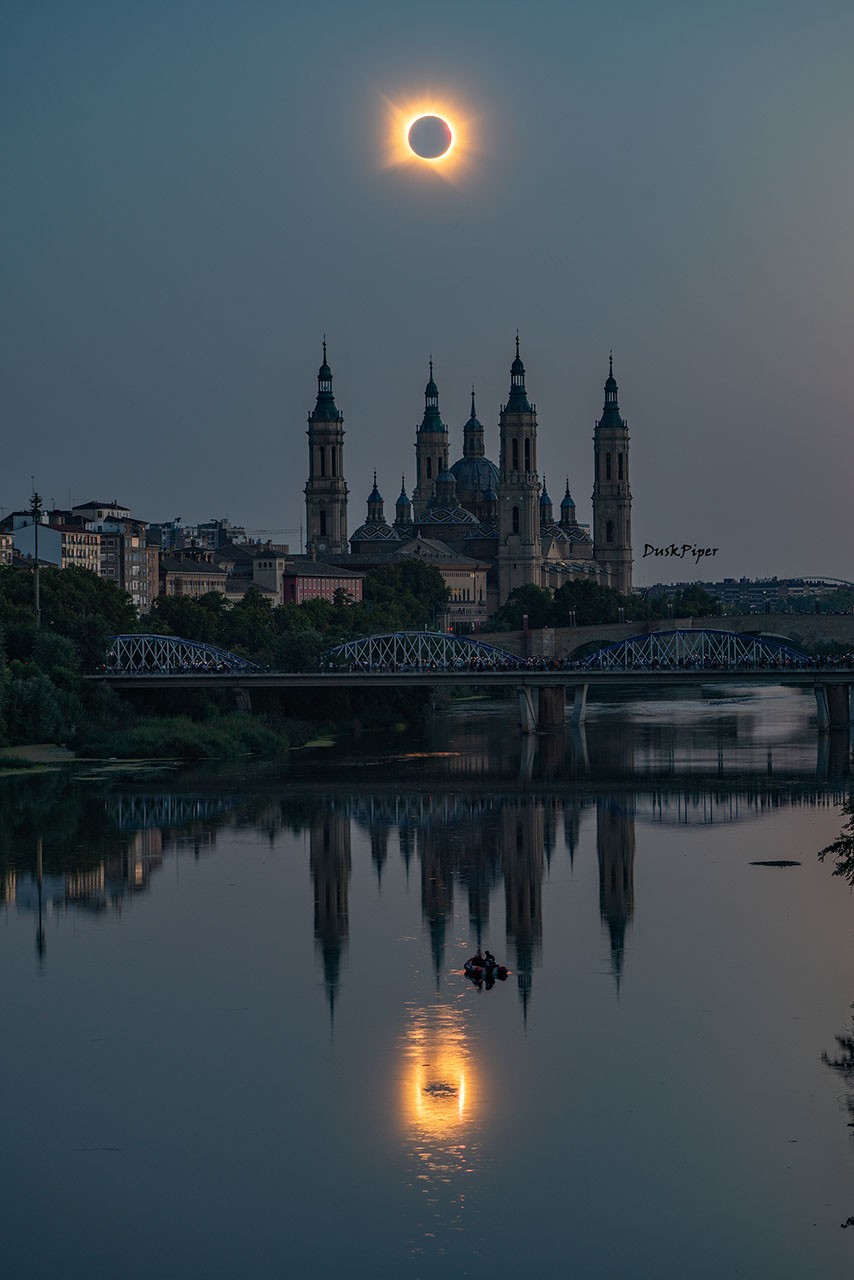
A total solar eclipse on August 12, 2026 swept the Moon's shadow across Siberia, Greenland, Iceland, Spain, and Portugal. NASA's Astronomy Picture of the Day featured two photographs of the event taken from Zaragoza, Spain — one showing totality over the Cathedral-Basilica of Our Lady of the Pillar and one showing it reflected in the Ebro River. The image is credited to Ruiyu Zhang.
The eclipse was Spain's first major total solar eclipse since 1905, according to the APOD description.
During totality, observers may experience a drop in air temperature, birds falling quiet, insects chirping in confusion, and what the post describes as 'the shared awe of many.'
With the Sun's bright disk blocked by the Moon, the solar corona becomes visible. Scientists study eclipses in part to investigate why the corona reaches temperatures millions of degrees higher than the Sun's surface.
Members of the public can contribute to eclipse science, according to the post, by recording wildlife behavior, imaging the corona, and monitoring air temperature and cloud cover.
The APOD entry was dated August 13, 2026, and was written by Keighley Rockcliffe, Robert Nemiroff, Jerry Bonnell, and Cecilia Chirenti. It is a service of the ASD at NASA/GSFC, NASA Science Activation, and Michigan Technological University.
- No eyewitness accounts or observer reactions from Zaragoza or other locations along the eclipse path are included.
- No scientific data or preliminary findings from corona observations or wildlife monitoring during the eclipse are cited.
- No information is provided on the duration of totality at any location.
- No details are given on the width of the Moon's shadow or the precise path it followed across each named region.
- No comparison is made between this eclipse and the 1905 eclipse in Spain.