The Connecticut chapter of the American Civil Liberties Union filed a federal lawsuit on Wednesday alleging that the Hartford immigration court is withholding access to basic court records, naming U.S. Attorney General Todd Blanche and Hartford chief immigration judge Angela Munson as defendants.
ACLU-CT sues Hartford immigration court over withheld docket records
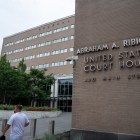
The Connecticut chapter of the American Civil Liberties Union filed a federal lawsuit on Wednesday alleging that the Hartford immigration court is withholding access to basic court records, naming U.S. Attorney General Todd Blanche and Hartford chief immigration judge Angela Munson as defendants.
According to the complaint, ACLU-CT twice requested all docket numbers and case captions for May 2026 through July 2026, as well as all in absentia removal orders — orders issued when people with pending immigration cases do not appear for hearings — and received no response either time.
The organization argues that such records should be available under the First Amendment and should not require a Freedom of Information Act request, which gives the government the right to withhold certain information and can take months to fulfill. ACLU-CT said it wants the information contemporaneously, to monitor court activity in close to real time.
Dan Barrett, legal director for ACLU-CT, said that while the public can attend hearings and view the day's docket, that is not a practical means of obtaining a broad picture of court activity — including the details of in absentia removals or removals to third countries. Barrett added that the group is not seeking to have individuals' information proactively published in a public database; rather, it argues Americans should have the right to request and quickly receive such information without going through FOIA.
The lawsuit asks the U.S. District Court to declare that the immigration court is bound by the First Amendment right of public access and to prohibit Blanche and Munson from blocking the ACLU's records requests. Barrett said he expects that, if access is granted, the court would adopt rules automatically sealing sensitive details such as asylum applicants' names, similar to protections that exist in state and federal trial courts for minors' names, birthdates, and Social Security numbers.
Barrett noted that the case has the potential to set legal precedent with implications beyond Connecticut. A Department of Justice request for comment was not immediately returned.
Privacy and safety concerns surround the release of immigration court data. Full names are typically withheld under FOIA on privacy grounds, Barrett said. Some immigration cases involve asylum seekers fleeing persecution by foreign governments, making their identities potentially sensitive. Late last year, Connecticut state lawmakers passed legislation barring public agencies, including schools, from sharing individuals' addresses, work hours, appointments, or other information indicating where a person may be located, in response to federal requests for state-level data that could be used for U.S. Immigration and Customs Enforcement action.
Case-level immigration court data is currently available through the Executive Office for Immigration Review, a Department of Justice division, but those releases do not include identifying information such as respondents' names. The datasets include case outcome, respondent birth year, nationality, primary language, relief applied for, and whether the most recent proceeding was an in absentia hearing, among dozens of other fields.
According to immigration court data requested by the Deportation Data Project, more than 99.8% of cases decided in Hartford with in absentia rulings this year have resulted in a removal order. A CT Mirror analysis of Hartford immigration court data found that a higher share of cases this year, and particularly this summer, were closed in absentia. In May alone, respondents in more than 90% of cases closed that month did not appear for their court date. From January through August 1, more than 79% of Hartford cases were marked in absentia at a final hearing. The analysis also found that 2025 had the next-highest in absentia rate in at least 10 years, second only to 2026, with 41% of respondents not appearing at their last court date.
U.S. Senator Richard Blumenthal, Democrat of Connecticut, on Tuesday attended Hartford immigration court and spoke with media afterward, saying he sought to observe what he called a 'snapshot of what seems to be purposeful chaos in the immigration court.' Blumenthal said many people failed to appear on Monday, in some cases likely because they were not given adequate notice, and that failure to appear can result in an in absentia removal order.
- The source does not state whether the Hartford immigration court or the Executive Office for Immigration Review has offered any explanation for not responding to the ACLU-CT's two records requests.
- The source does not state in which federal district court the lawsuit was filed or provide a case number.
- The source does not establish whether any other ACLU chapter or organization has filed a similar First Amendment lawsuit against an immigration court elsewhere in the country.
- The source does not state what specific relief, if any, ACLU-CT is seeking on an emergency or expedited basis, or whether it has requested a preliminary injunction.
- The source does not provide data on why individual respondents did not appear at Hartford immigration court hearings, noting only that in some cases adequate notice may not have been given.
- The source text supplied appears truncated; some material may be missing — specifically, the CT Mirror analysis is referenced but the full methodology and scope of that analysis are not described.
Read the original at CT Mirror